




When a familiar prompt feels like part of the job
Lisa is updating a customer record between calls. The CRM is open, the notes are half-finished, and the next meeting is close enough to shape how quickly she works.
A prompt appears on screen.
“For security reasons, please log back in to continue.”
It looks familiar. It carries the company branding. It appears inside a system she uses every day, at a point where a session timeout would not feel unusual. The simplest decision is to click, sign back in and finish the update before the next call starts.
That decision does not feel like a cybersecurity decision.
It feels like keeping the work moving.
Lisa is not ignoring guidance. She is trying to avoid losing progress, keep the customer record accurate and move on without delay. Clicking through feels practical because it fits the task already in front of her.
This is the kind of moment the Quick Cyber Awareness Session helps people notice sooner.
The setting changes from team to team. It might be a CRM prompt, a document request, a password change banner, a supplier message, an invoice query or a shared-folder notification. The underlying pattern is similar: something appears inside a trusted workflow, nothing feels wrong enough to interrupt progress, and the quickest response feels sensible.
Quick cyber awareness gives teams a clear starting point for recognising those moments while they are still happening. In two hours, the session explores how risk can form inside normal work, why certain actions feel reasonable at the time, and when a familiar-looking prompt, request or message deserves a brief check before the task moves on.
It is not designed to do the job of a deeper workshop or full training programme. Its role is simpler and sharper: to help people see the moments sooner.
Why awareness often disappears inside the task
A cyber incident does not have to begin with something that looks obviously dangerous.
It can begin with something that appears to belong.
A system asks for a login at a believable point in the task. A document arrives from someone the team recognises. A payment query fits into an existing supplier conversation. A shared-drive request appears while someone is trying to get work finished before a deadline.
The issue is not always a lack of knowledge. People may already know the policy. They may understand that links, prompts, files and requests should be checked. The difficulty is that live work does not present itself like a training example.
It arrives with pressure attached.
Someone may be trying to complete a task, avoid delay, support a colleague, respond to a customer, meet a deadline or keep a process moving. Familiar systems can lower scrutiny because they normally behave as expected. Repeated tasks can become easier to complete automatically. A request that fits the workflow may feel trustworthy because it makes sense in the moment.
That is where awareness can stop short.
Guidance can explain good practice when there is time to think. Posters, policies and online modules can describe the right answer from a distance. But the decision may still happen with a task open, attention split and other priorities already pressing in.
Knowing what should happen and noticing the moment to apply it are not the same thing.
The Quick Cyber Awareness Session stays close to that gap. It helps people recognise the small point where routine work becomes a judgement call: the moment where continuing feels normal, but checking would be wise.
The session makes that point easier to recognise without turning people into security specialists or slowing every task down. A useful pause becomes easier to understand. Verification feels less like overreacting. Asking a quick question becomes part of completing the job properly rather than a sign that someone is blocking progress.
What the Quick Cyber Awareness Session does
The Quick Cyber Awareness Session is a live, practical two-hour session for teams that need a clear starting point.
It helps people recognise the cyber decisions already sitting inside ordinary work. Rather than moving through long threat lists or generic awareness messages, the session begins with situations people can picture: a task is underway, something appears to fit, and responding feels like the most practical way to keep the work moving.
Participants examine what makes those moments difficult to notice. A familiar system can make a prompt feel trustworthy. An existing supplier conversation can make a change of details seem expected. A request from a colleague can feel more important to complete quickly than to question. These decisions do not begin with someone choosing to take a risk. They begin with someone trying to complete their work.
The session helps teams recognise where a brief pause or separate check belongs before the action is completed. The aim is not to make people suspicious of every message, prompt or request. It is to help them notice when something that appears normal still needs verification.
A quick session should not try to do everything. Its role is to create early recognition, give people a shared language and make useful checks easier to apply during live work.
For some organisations, that is the right level of support. For others, the session may reveal repeated patterns across departments, approvals, handovers or role-specific workflows. Where teams need more time to examine and practise those decisions together, a Half-Day Workshop, Full-Day Programme or Tailored Programme may be more appropriate.

What happens during the session
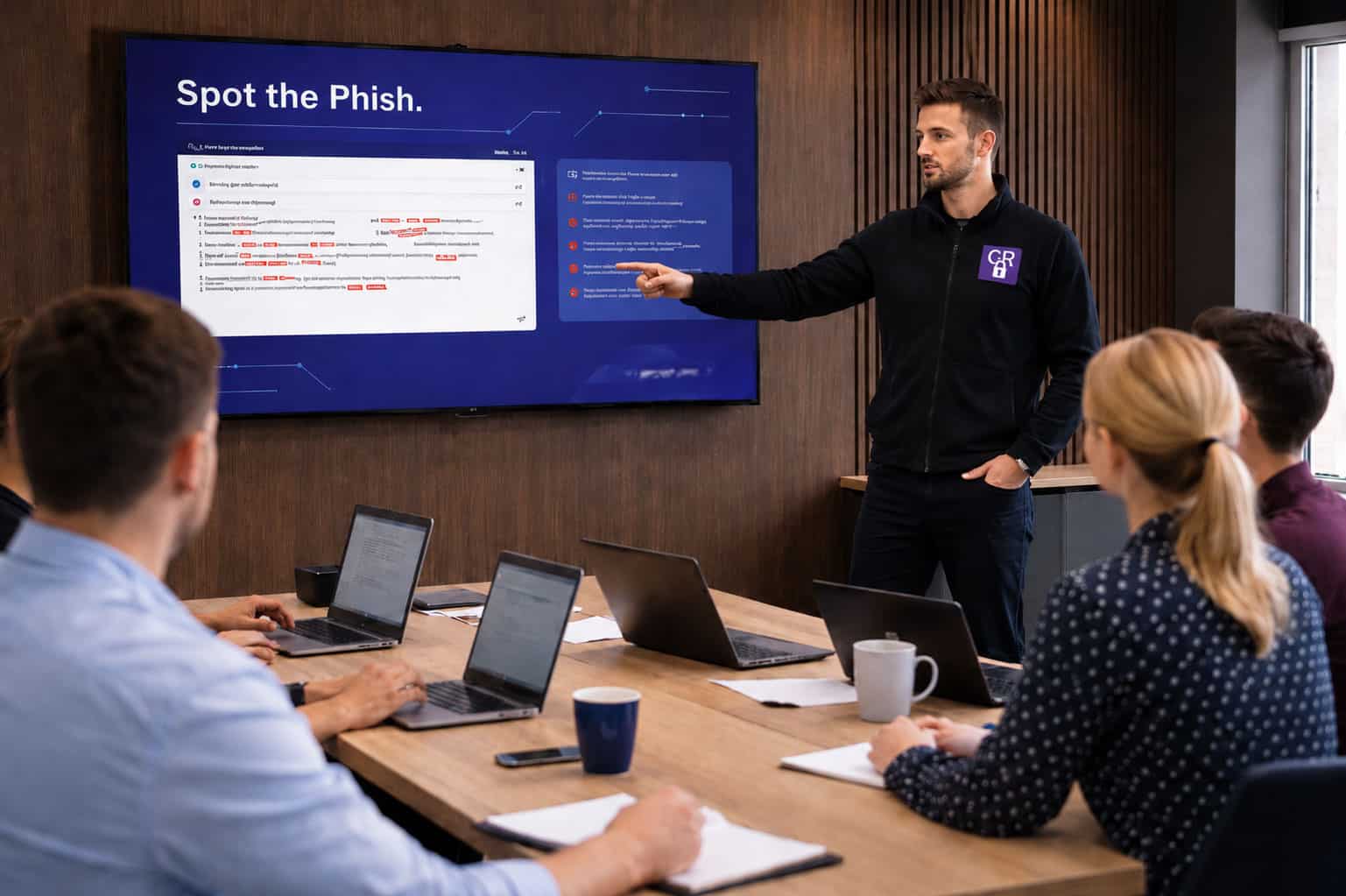
The session is delivered live online or on-site and combines discussion, questions and realistic workplace examples rather than relying on a one-way presentation. It is suitable for complete beginners and mixed-experience teams, with no technical knowledge required.
A typical session lasts two hours and works particularly well with groups of up to 30 people, although the delivery can be shaped around the size of your team so that the level of discussion and participation still feels right. Beforehand, we agree the audience, priorities and relevant working context, and you can let us know about any particular requirements, examples or situations you would like reflected in the session. Cyber Rebels is a CPD Approved Provider, and participants receive an appropriate certificate following completion.
Participants explore realistic prompts, messages, requests, files, access decisions and routine actions that may appear legitimate at first. The discussion looks beyond whether someone chose the right or wrong response. It examines what they were trying to complete, what made the situation feel familiar and how speed, trust, authority, responsibility or convenience shaped the decision.
That approach gives people room to examine the moment without feeling judged. It may reveal that a shortcut exists because the formal process takes too long, that staff are unsure when they can challenge an unusual request, or that a checking route is clear on paper but awkward to use while the work is moving.
The session is structured around the Cyber Rebels Five-Domain Model, covering contextual risk recognition, verification, secure operational behaviour, escalation and professional judgement under pressure. The model gives the training direction while keeping the discussion grounded in real work rather than abstract theory.
Because the session is live, participants can ask questions, test assumptions and discuss how similar moments appear in their own environment. The aim is to give people a clearer way to interpret those situations: not simply knowing more about cybersecurity, but noticing sooner when a routine action has become a judgement call.
That may mean reaching a familiar system through the normal route rather than the link in front of them, confirming an unusual request through a separate channel, or asking a proportionate question before continuing. These are small changes in how a task is handled, but they are the point of the session. They help verification and escalation become part of completing the work properly rather than something added after the decision has already been made.
Who this session is for
The Quick Cyber Awareness Session is designed for organisations that need a practical first step rather than detailed scenario work or a longer training programme from day one. It works particularly well where people are busy, responsibilities overlap and decisions are made quickly inside familiar systems. That may include customer-facing teams, administrators, finance teams, operational staff, managers, remote and hybrid workers, charities, education providers, professional services firms, SMEs and growing organisations.
The common factor is not the sector. It is the way the work happens.
A customer record needs updating between calls. A document needs sharing before a meeting. A supplier query arrives while another task is already waiting. A colleague needs access to keep a piece of work moving. Each decision is small enough to feel routine, but important enough to matter when the wrong route is used.
The session is particularly useful where previous awareness has faded into the background, several teams need a shared starting point or leaders know support is needed but are not yet sure how much depth is appropriate. It can also help an organisation see whether the issue is mainly one of recognition or whether wider problems around process, authority, checking routes or role clarity need attention.
It is less suitable where the organisation already needs detailed role-specific exercises, decision mapping across several departments, leadership alignment or deeper practice around verification and escalation. Those needs are better served by a Half-Day Workshop, Full-Day Programme or Tailored Programme.
What happens when routine decisions go unchecked
Cyber awareness can be postponed while the work still appears to be moving.
Messages are answered, documents are shared, customer records are updated and requests are processed. Nothing has clearly gone wrong, so the small decisions behind that activity remain difficult to see.
Over time, familiar responses can become part of how work gets done. Someone may continue through a prompt because that has worked before, trust a request that appears inside a known system or use a shortcut because the formal route feels slower than the task allows. They may avoid asking a question because they do not want to create friction around something that looks routine.
Each action may make sense in isolation. The concern is what happens when the same decision pattern carries across inboxes, shared drives, customer systems, finance processes, supplier conversations and access requests.
An organisation may believe that people are following the intended process because the policy is clear and the work is being completed. Staff may believe they are acting sensibly because their response is quick, helpful and consistent with what normally happens. The gap sits between those two views: what the organisation expects and what the live environment makes easiest.
Training alone cannot correct an unusable process, unclear ownership or a checking route that does not fit the pace of the work. A focused session can help bring those conditions into view by examining where judgement is being relied upon, where safer actions feel awkward and where the organisation may need to make them easier.
Addressing those patterns does not require turning every task into a security exercise. It begins by helping people recognise the point where routine work deserves a second look.
Cyber awareness people can discuss without blame
The Quick Cyber Awareness Session avoids fear-based messaging, exaggerated scenarios and language that treats people as the problem.
Those approaches may attract attention, but they can make honest discussion harder. When someone expects to be criticised for using a shortcut or responding too quickly, explaining why that response felt necessary may become more difficult. The organisation can then see the action while missing the pressure, process or expectation that shaped it.
Cyber Rebels begins by examining why the decision made sense.
Someone may be trying to help a colleague, respond to a customer, meet a deadline or prevent a task from stalling. Recognising that does not remove responsibility or suggest that every action is acceptable. It makes it easier to understand what needs to change.
Sometimes the useful change sits with the individual: noticing the moment sooner, checking through a separate route or escalating uncertainty proportionately. Sometimes the discussion exposes something around them: an unclear process, conflicting expectations, limited authority to pause or a control that is harder to use than the shortcut.
The aim is not to make teams suspicious of everything. It is to make verification feel like a normal part of completing the task properly and give people a clearer route for raising uncertainty before something has gone wrong.
See where these decisions already happen in your team
The Quick Cyber Awareness Session is a practical place to begin when your organisation wants to strengthen cyber awareness without adding unnecessary complexity.
It helps teams recognise where everyday cyber decisions already happen, why those moments are easy to miss and what a more useful response can look like while the work is still moving.
For some organisations, a focused two-hour session may provide the shared recognition they need. For others, it may reveal decisions that need more time, role-specific practice or changes to the surrounding process.
The useful first step is to understand where these moments already sit inside your organisation: where prompts appear, where unusual requests arrive, where checks feel awkward and where speed or familiarity tends to take over.
The free Cybersecurity Risk Check takes around two minutes and can help bring those decision points into view. Your answers can help you judge whether the Quick Cyber Awareness Session is the right starting point or whether your team may need deeper support.
