




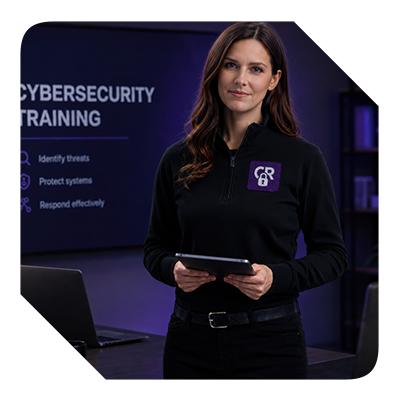


Cybersecurity training built for real working decisions
A member of staff is halfway through a normal task when something appears that fits exactly with what they are already doing. The name is familiar, the timing makes sense, and responding to it feels like the quickest way to keep things moving, so they act.
Nothing about that moment feels like a cybersecurity decision. It feels like doing the job.
That is where cyber risk most often forms: inside everyday work, where decisions are made quickly and everything appears legitimate.
Cyber Rebels training is built around that reality. Not just what people know, but how they interpret situations when work is live, pressure is present, and nothing clearly signals that something needs to be checked.
The aim is not to make people slower, more suspicious, or less able to get on with their work. It is to help them recognise when a familiar situation deserves a second look and respond with more clarity while the task is still moving.
Why our training works in real conditions
Our training is built for the point where generic awareness usually stops being enough.
In most organisations, risk does not arrive as something obvious. It appears in the middle of normal work: a familiar request, a routine-looking prompt, a process step that seems close enough to what people would expect that continuing feels more sensible than stopping. At that point, the issue is not whether someone has heard the guidance before. It is whether the situation in front of them feels like it actually requires them to apply it.
That is the gap our training is designed to close.
Rather than delivering generic content, we shape each session around the environments, pressures, and decision patterns people are already dealing with in practice. We use realistic scenarios, role-based discussion, and live interaction to examine how decisions are actually made when work is underway, time is limited, and nothing clearly signals risk.
This is where many training approaches begin to fall short. They explain what people should look for, but often do so in conditions where the risk is already visible, the scenario is clearly framed, and the right response can be worked out at a distance. Real work rarely feels like that. Most decisions happen while people are already busy, already committed to the task, and trying to keep progress intact.
Without that connection to real conditions, awareness does not consistently become behaviour. The issue is not simply knowledge. It is that the decision being made in the moment still feels like a work decision, not a security one.
Our focus is on changing how those moments are handled in practice: recognising when something familiar deserves a pause, knowing what needs to be verified, feeling clearer about when to escalate, and responding in a way that supports the work rather than disrupting it unnecessarily.
This thinking sits behind the Cyber Rebels Five-Domain Model, which gives structure to the behaviours that matter most in practice, from recognising risk in context through to making proportionate decisions under pressure.
All training is delivered live rather than through pre-recorded modules, because people do not just need information. They need enough clarity, challenge, and shared understanding to apply it when the situation feels normal and the decision has to be made there and then.
What’s Included in Our Training?
Recognising Risk in Everyday Risk
Cyber risk rarely looks like an obvious attack. More often, it appears inside routine tasks — emails that seem normal, requests that feel expected, and actions taken to keep things moving. We help employees recognise risk in those moments, where nothing immediately feels wrong and that is exactly why it is often missed.
Phishing & Impersonation in Practice
Most phishing emails do not look suspicious. They look relevant, timely, and often come from names people recognise. We explore how these messages blend into normal communication and how to question them without disrupting workflow or second-guessing everything.
Stopping Malware Before It Starts
Malware rarely arrives with a warning. It often enters through everyday actions — opening a file, clicking a link, or installing something that seems necessary to complete a task. We focus on how these situations happen in practice and how small decisions can prevent much bigger problems.
Secure Communication That Fits How You Work
From email to Teams and shared platforms, communication is fast, constant, and often taken at face value. We help teams handle information securely within these environments in a way that supports the pace of work rather than slowing it down.
Passwords, Access & Real-World Behaviour
Password habits are usually shaped by convenience, familiarity, and time pressure, not by a lack of awareness. We help employees understand why risky habits form and how simple controls such as MFA support better decisions in real situations.
Handling Data in Real Situations (GDPR)
Data protection is not just about policy. It is about how information is handled during everyday tasks, from sharing files to responding to requests and using the right systems. We focus on how those decisions play out in practice and how GDPR and data protection principles can be applied consistently in the flow of work.
Knowing What to Do When Something Feels Off
Recognising risk is one thing. Knowing what to do next is where people often hesitate. We help employees respond with more confidence, escalate appropriately, and act without fear of blame or getting it wrong.
Staying Secure in Remote & Hybrid Work
Working across devices, networks, and locations creates risks that do not always feel obvious in the moment. We show employees how to manage those environments safely based on how they actually work, rather than on ideal conditions that rarely exist in practice.
How the training works in real conditions
In practice, cybersecurity training should not feel like a separate activity dropped on top of the working day. It should feel like a clearer way of understanding the work your team already does, the decisions they already make, and the moments where risk forms without looking like risk at all.
Sessions are built around familiar situations: an email that looks right, a request that needs a quick response, a login prompt that appears at the wrong moment, or a task that needs completing before the next thing begins. Nothing appears obviously risky, and that is the point. These are the moments where decisions are made quickly, with the intention of keeping work moving, being helpful, and avoiding unnecessary delay.
That is where many training approaches begin to stop short. Guidance can explain what good practice looks like, but real decisions are made while work is already moving, attention is already divided, and the easiest next step often feels like continuing. Knowing the guidance and applying it in that moment are not always the same thing.
We work through those moments in context — what the person sees, what they are trying to do, what else is competing for their attention, and why their decision makes sense at the time. The focus stays grounded in how your organisation actually operates, including workload, time pressure, communication habits, internal processes, and the expectation to respond without slowing everything down.
From there, the conversation shifts to how those situations can be handled differently without disrupting the flow of work. That might mean noticing when something deserves a second look, knowing what to question, checking through a different route, or applying verification in a way that feels proportionate rather than obstructive.
Because sessions are live and discussion-led, people can ask questions, test assumptions, and challenge the kind of situations that often get brushed past in generic training. That matters, because the goal is not simply to tell people the right answer. It is to help them understand why certain decisions feel reasonable in the moment, and what needs to change for a different response to become realistic in practice.
People often recognise their own experiences in what is being discussed. They can see how urgency, familiarity, convenience, and trust shape decisions in ways that do not feel careless, just normal. That recognition is usually where the shift begins.
Over time, that shift shows up in small but important ways: a pause before acting, a quick check where there would not have been one before, more confidence in questioning something that feels routine, or an earlier decision to escalate when something does not sit right. These changes may be subtle, but they are what reduce risk in practice, because they hold up in the moments where decisions are actually being made.
Why Organisations Work With Cyber Rebels
Start the conversation
If this feels familiar, it will probably reflect something many organisations already recognise. Awareness is often in place, but the real challenge tends to sit in the moment where decisions are made.
Looking at how those moments show up in your own environment can bring useful clarity — both in what is already working well and where small changes could make a practical difference.
If it would be helpful to talk that through, we’d be happy to explore it with you.
General enquiries
Got a cybersecurity challenge in mind?