




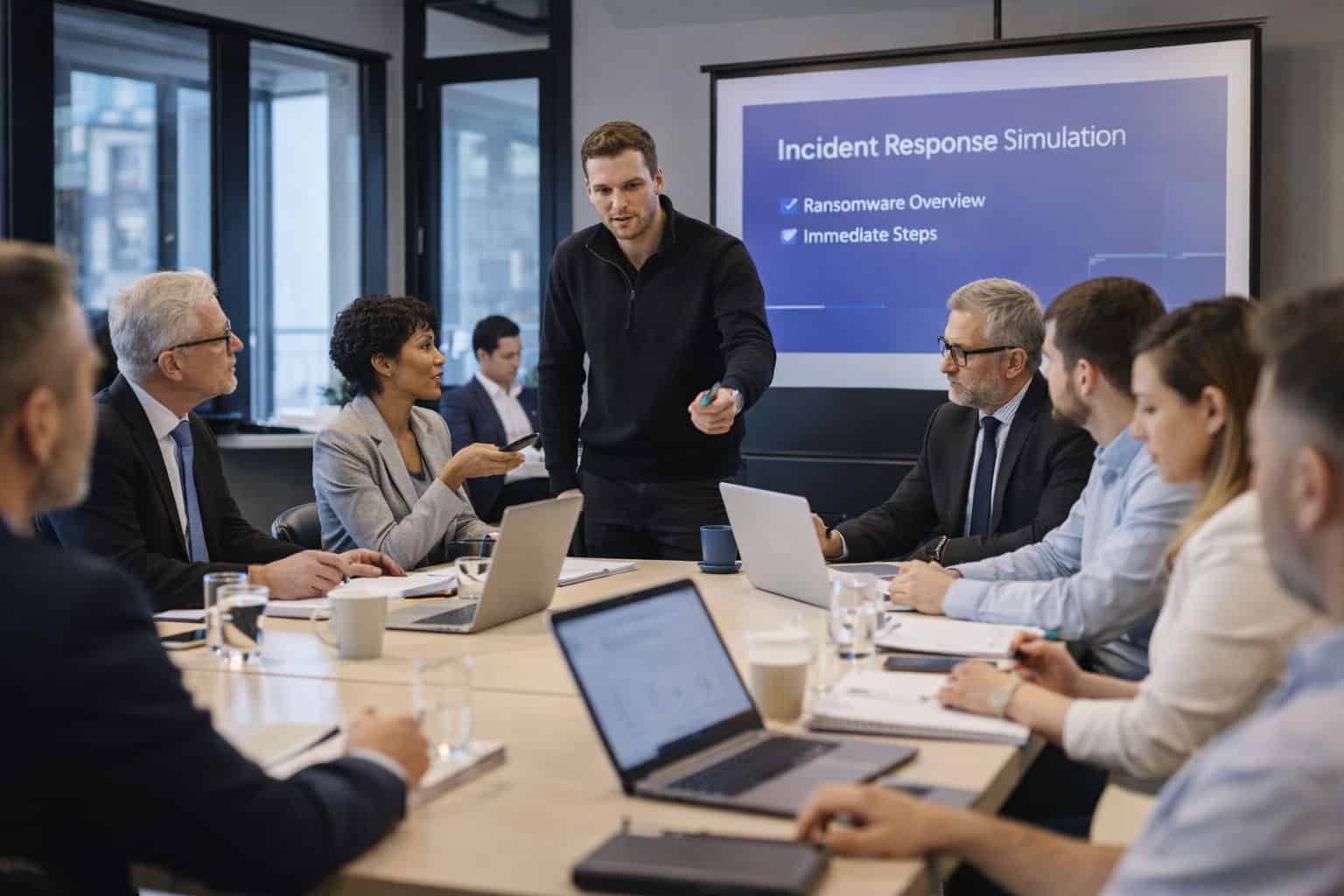
Full-day training for shared team judgement
A shared inbox is open, a response is almost ready to send, and the team is trying to close the task before the end of the day.
One person has drafted the reply. Another has checked the customer details. A manager has been copied in. Just before it goes out, a colleague adds a quick note in chat.
“Can you include the updated attachment before sending?”
The file name looks familiar. The request fits the timing. The work has already moved through several people, so sending it now feels like the simplest way to finish the task and avoid another round of delay.
In that moment, the decision does not feel like cybersecurity.
It feels like teamwork.
No one is trying to take a shortcut. The team is trying to finish the work, support each other and keep the response moving. The action feels reasonable because the request sits inside a task that is already underway, with no clear reason to stop.
That is where shared judgement matters.
A Quick Cyber Awareness Session can help people notice moments like this sooner. A Half-Day Cybersecurity Workshop gives a team time to examine how the decision formed and where responsibility became unclear.
Some organisations need more depth. Similar decisions move repeatedly through shared inboxes, approvals, supplier conversations, customer work, access requests and handovers between teams. It is not enough for one group to agree what should happen if another role interprets the same situation differently when the pressure returns.
The Full-Day Cybersecurity Training Programme is designed for that level of support. It gives teams time to examine more complex decisions across roles, practise proportionate checks and escalation, and explore how a more consistent response could work as responsibility moves through the organisation.
The emphasis is not on adding more cybersecurity information. It is on giving people repeated opportunities to recognise uncertainty, verify through a trusted route, clarify ownership and discuss what should happen before an assumption travels into the next stage of the work.
Why shared decisions need more than awareness
Cyber awareness becomes harder to apply when a decision moves across roles, systems and handovers.
A message may be drafted by one person, checked by another and approved by someone else. A supplier change can move from an inbox into a finance system. A file request may pass through a manager before reaching the colleague with access. A customer issue can cross several teams before anyone feels fully responsible for questioning it.
Each person sees a reasonable part of the task. The person preparing the work may focus on accuracy. The manager may assume an earlier check has taken place. The final approver may believe that the number of people already involved provides reassurance.
The uncertainty sits between those interpretations.
A short session can make that pattern easier to notice. A half-day workshop gives one team room to examine how it formed. The full-day format becomes useful where the organisation needs to go further: comparing decisions across roles, revisiting the response through more than one scenario and exploring how ownership, verification and escalation should connect when the work changes hands.
That depth matters because these situations do not appear in only one process. They may surface in shared inboxes, supplier requests, onboarding, customer support, document handling, remote work, internal chat, access approvals and finance. A response that works in one situation may still need adapting when the authority, pressure or handover changes.
The programme therefore gives participants repeated opportunities to work through how uncertainty forms, where assumptions enter the process and what a proportionate response could look like before responsibility moves on.
What the full-day programme helps teams do
The Full-Day Cybersecurity Training Programme is for organisations that need more than recognition or a single team discussion. It gives participants time to work through more complex decisions, return to the same capability from different roles and explore how a shared response should hold together across handovers and repeated pressure points.
A Quick Cyber Awareness Session helps people see when ordinary work has become a judgement call. A Half-Day Workshop lets a team stop and examine one of those decisions together. The Full-Day Programme adds repeated practice. Participants can compare how verification, ownership and escalation change when the situation moves from one role, process or system to another.
That distinction matters. A full-day programme is not simply a longer awareness presentation. The additional time allows the training to move from initial recognition into scenario work, discussion, comparison and further practice. A response can be tested from the perspective of the person receiving the request, the manager overseeing the task and the colleague with authority to complete it.
The programme is planned around the organisation, audience and priorities. The balance of scenarios, discussion and practice can reflect participant experience, the responsibilities represented in the room and any particular requirements agreed beforehand. The delivery should feel relevant to the decisions those teams handle without becoming a fully organisation-specific programme.
Where the training needs to be built extensively around internal systems, named workflows, detailed responsibilities or several distinct operating environments, the Tailored Cybersecurity Training Programme is the stronger fit.
The Full-Day Programme therefore occupies a clear place in the training ladder: enough time for alignment and repeated practice across roles, without requiring the deeper organisational design of a tailored programme.

Inside the Full-Day Training Programme
It works particularly well with groups of up to 30 participants, giving people enough space to contribute, compare perspectives and take part in the scenario-based discussion.
Beforehand, we agree the audience, priorities and relevant working context. You can also let us know about particular requirements, examples or situations you would like reflected in the day. The delivery is then shaped around the organisation, the participants and the level of practice and discussion that will be most useful.
Participants examine decisions involving shared inboxes, supplier requests, access changes, customer information, document handling, internal messages, login prompts, remote working and handovers between teams. The precise examples can reflect the responsibilities in the room, while the central question remains the same: what happens when a familiar task reaches a point where someone needs to recognise uncertainty, verify what they have been given or prevent an assumption from travelling further?
The programme follows the Cyber Rebels Five-Domain Model, covering contextual risk recognition, verification and control discipline, secure operational behaviour, incident judgement and escalation, and professional cyber judgement. The model provides structure across the day without turning the training into a technical lecture.
Participants move from recognising individual moments into examining how decisions connect across roles and processes. They can compare how the same situation appears from different positions, identify where responsibility becomes unclear and practise how a useful response might work before the pressure is real.
That practice may include confirming a request through a separate known route, deciding who owns verification before an approval moves forward, limiting access to what a role needs or raising uncertainty without treating the situation as an emergency. Participants can then revisit those capabilities through different scenarios, helping the group explore whether the response still works when the task, authority or handover changes.
The discussion may also reveal where the surrounding process makes a safer response difficult, such as an unclear escalation route, conflicting priorities or a control that relies heavily on informal trust. Training cannot resolve those organisational conditions by itself, but it can help distinguish between a capability that needs practice and a working arrangement that needs attention.
Cyber Rebels is a CPD Approved Provider, and participants receive an appropriate certificate following completion.
Who the full-day programme is for
The Full-Day Cybersecurity Training Programme is designed for organisations that need stronger alignment across roles, handovers and repeated decision points.
It works particularly well where no single person holds the whole picture. This may involve finance and operations teams, managers and approvers, customer-facing colleagues, education or safeguarding roles, regulated services, remote and hybrid teams, or any organisation where data, access, payments, service delivery or public responsibility move across several hands.
The programme is suitable for complete beginners and mixed-experience teams because the discussion begins with recognisable work rather than technical knowledge. Participants do not need the same role or level of cybersecurity experience. The value comes from comparing how different responsibilities and pressures shape the same decision.
It is particularly useful where people already understand the broad guidance but the organisation is less certain about what happens when that knowledge has to hold across a process. Who confirms an unusual supplier request? Who checks an attachment that has already passed through the team? Who owns verification when one person prepares the work and another approves it? Who has permission to pause when several people are waiting?
These are not simply awareness questions. They concern repeated practice, shared ownership and the ability to discuss uncertainty across responsibilities.
A Half-Day Workshop may provide enough depth where one team mainly needs to examine how its decisions fit together. The Full-Day Programme is the stronger option where participants need time to work through several situations, revisit the response and explore alignment across roles or handovers.
Where the training needs to be designed closely around specific internal systems, named workflows, responsibilities or operating conditions, a Tailored Cybersecurity Training Programme may fit better.
What happens when shared decisions rely on assumption
When responsibility is spread across a team, assumptions can begin to replace checks without anyone deliberately deciding to ignore the process.
A request appears reasonable because it arrived through a familiar route. A file is trusted because a colleague forwarded it. A payment change progresses because the supplier relationship is established. A concern stays unspoken because the task has already been reviewed or approved by somebody else.
From each person’s position, continuing may feel sensible. The difficulty is that every handover can carry forward an assumption made earlier in the process.
Over time, this can create a gap between the process the organisation expects and the route live work makes easiest. Written guidance may require verification while decisions still depend on familiarity, informal ownership or whether someone feels able to interrupt the task.
The Full-Day Programme gives participants enough time to examine that pattern through more than one situation. They can explore where checks are being assumed, compare who different roles believe owns the next step and practise how uncertainty might be raised before it passes into another part of the work.
Training cannot repair an unusable process, clarify authority the organisation has not assigned or make an impractical checking route workable. The discussion can, however, help distinguish between judgement that needs further practice and a surrounding condition that requires attention from leadership, process owners or technology.
That boundary matters. The aim is not to ask people to become more vigilant inside the same unclear system. It is to explore both the participant response and the organisational support needed to make that response realistic when the decision appears again.
Calm, practical training for shared judgement
The programme avoids fear-based messaging, exaggerated scenarios and language that treats people as the problem.
When someone expects to be criticised for trusting a familiar request, using a shortcut or allowing a task to continue, they are less likely to explain what made that response feel necessary. The organisation sees the action but misses the workload, process, expectation or uncertainty around it.
The discussion begins with the work. What was the person trying to complete? What made the request appear legitimate? Where did responsibility become unclear? What would have made a better response easier to take?
Participants can then examine what would have helped: clearer ownership, a more practical checking route, permission to pause, better language for raising uncertainty or a shared understanding of when escalation is proportionate.
This creates space for people to question how work happens without turning the discussion into blame. It also allows leaders and process owners to consider where expectations, controls or working arrangements may be making a safer response harder than intended.
The aim is to give teams repeated opportunities to explore clearer ownership, proportionate verification and practical ways to raise uncertainty across the points where work and responsibility meet.
Check whether your team needs a full day of shared practice
The Full-Day Cybersecurity Training Programme may be the right next step where the challenge is not simply whether people know what to do, but whether recognition, verification and escalation need to hold together across roles, handovers and repeated situations.
The signs often appear in the work itself. Who pauses? Who verifies? Who assumes a check happened earlier? Who owns the next step when one team prepares the work and another approves it? What happens when the same uncertainty appears through a different process?
A Half-Day Workshop may be enough where one team needs to examine a shared decision in more depth. A full day becomes more useful where participants need repeated opportunities to compare roles, practise responses and test whether the same approach still works when the situation changes.
Where the training needs to be built closely around specific systems, workflows, responsibilities or organisational conditions, a Tailored Programme may provide the stronger route.
The free Cybersecurity Risk Check takes around two minutes and helps bring these decision points into view. Your answers can help you judge whether the Full-Day Programme offers the right level of support or whether a half-day or more tailored approach would fit more closely.
