


Artificial intelligence has become both the promise and the paradox of our time. It’s the silent assistant that writes our reports, predicts market trends, and keeps networks safe from attack — yet it’s also the engine behind voice clones, deepfakes, and misinformation that spreads faster than truth.
Every headline tells a different story. In one, AI is saving lives. In the next, it’s taking jobs, distorting reality, or quietly eroding trust. The world is divided between those who see AI as humanity’s greatest achievement and those who fear it as our final mistake.
But the question that underpins all of it — Is AI a threat? — may be the wrong one. Because AI doesn’t have ambition. It doesn’t wake up wanting control. It doesn’t choose who to deceive or who to protect. It simply learns from what we show it, and it mirrors what we prioritise.
That’s why the more revealing question isn’t whether AI is dangerous — it’s why it becomes that way in our hands. The real story of AI isn’t about machines thinking for themselves. It’s about humans creating intelligence faster than we can teach it empathy.
Cybersecurity sits at the heart of that tension. In this space, the line between innovation and exploitation grows thinner every day. The same algorithms that defend our systems can also be turned against us. The same automation that saves time can spread harm just as efficiently.
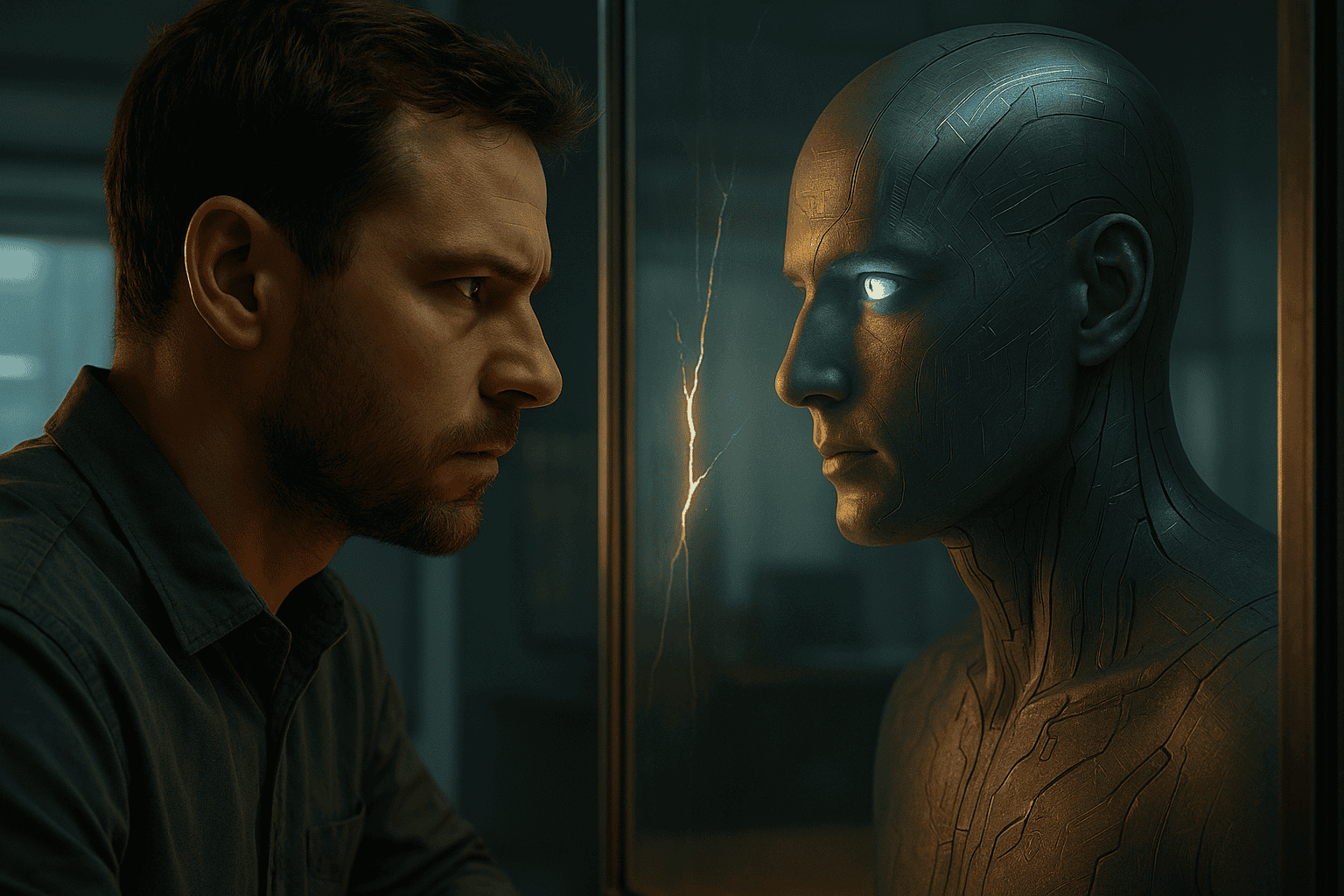
So maybe the threat isn’t artificial at all. Maybe what we’re really confronting is a reflection — a version of ourselves rendered in code, magnified by power, and stripped of conscience. AI isn’t teaching machines to think; it’s teaching us to see what thinking without ethics looks like.
The Problem Isn’t Artificial Intelligence — It’s Artificial Morality
When we say “AI has gone wrong,” what we usually mean is that it’s done exactly what it was told — just not what we intended. Artificial intelligence doesn’t rebel. It follows instructions, absorbs data, and optimises outcomes. The problem is that it does so without hesitation or conscience.
It has no instinct to question the goal, no sense of proportion, no pause before crossing a moral line. It doesn’t understand the human cost of efficiency. So when we train AI to maximise engagement, it doesn’t see outrage or misinformation as harmful — just effective. When we ask it to automate customer support, it won’t notice if the “helpful” response accidentally exposes private data. It doesn’t recognise trust, only targets.
The real danger isn’t that AI will suddenly decide to deceive us. It’s that we’ll keep asking it to do more without realising how our values are being written into its code.
That’s the quiet “why” at the heart of this story — the reason AI becomes risky isn’t because it’s intelligent, but because it’s obedient. It mirrors our ambition, our bias, and our blind spots, and then scales them to industrial size.
Machines can’t distinguish between what works and what’s right. They only know what we reward.
If we prize speed, they’ll find shortcuts.
If we prize attention, they’ll manipulate emotions.
If we prize data, they’ll collect it — whether or not consent exists.
AI doesn’t invent greed, haste, or apathy; it simply reflects the parts of us that already do.
This is what we mean by artificial morality: a system capable of doing great things but utterly incapable of caring about them. Ethics aren’t written into algorithms — they live in the people designing and deploying them. And when those people assume the machine will make the right choice, they’ve already made the wrong one.
Every time we automate a decision, we’re also automating our assumptions. We’re teaching AI what matters by what we measure. Yet morality isn’t measurable. It’s relational. It’s the human pause between cause and consequence — the moment we ask, “Should we?” before we act. AI doesn’t have that pause, which is why we must.
What makes this so urgent is that AI’s moral blankness isn’t theoretical anymore. We’ve seen recruitment tools reject women because past data showed men getting promoted faster. We’ve seen deepfake scams replicate voices to steal millions. We’ve seen chatbots give dangerous advice because they didn’t understand context, only correlation. In each case, the machine didn’t make a moral error — we did, by assuming ethics were optional in the race to innovate.
So when we talk about threats, the question isn’t whether AI will outsmart us — it’s whether we’ll forget to outthink ourselves. The intelligence we’ve built isn’t artificial at all. It’s our reflection, polished to a shine and stripped of empathy. That’s why the answer to every AI risk begins and ends with people: the engineers who build it, the teams who deploy it, and the users who decide what they trust it to do.
The challenge isn’t keeping machines under control. It’s remembering that control alone isn’t the same as conscience.
And that’s the true difference between intelligence and wisdom — one calculates; the other cares.
From Helper to Hacker: How AI Amplifies Human Intent
AI has always been the ultimate collaborator — a tireless assistant capable of scanning, sorting, and solving in seconds what would take a human hours. In cybersecurity, it’s already become the silent guardian in the background, filtering suspicious traffic, detecting anomalies, and learning from patterns we can’t even see. It watches, listens, and predicts with a kind of quiet precision that feels almost reassuring.
But that same precision, in the wrong hands, becomes something else entirely. The same code that protects can also probe. The same model that recognises patterns in behaviour can exploit them. The same algorithms that defend systems can, with a few altered lines of instruction, find the weaknesses they were meant to secure.
AI doesn’t distinguish between builder and breaker. It doesn’t understand motive — only method. That’s why the shift from helper to hacker isn’t a technological one; it’s human. The machine doesn’t wake up and decide to deceive anyone — it’s simply answering the questions it’s given. And sometimes those questions are designed to cause harm.
It’s a strange paradox: the more capable AI becomes, the thinner the line grows between protection and exploitation. Tools like WormGPT and FraudGPT didn’t appear because machines became malevolent — they appeared because humans did what we’ve always done with powerful technology: we tested its limits. We asked it to write more convincing emails, more persuasive messages, more human-sounding scripts — and it obliged. AI didn’t invent manipulation; it just removed the friction from it.
And that’s the quiet danger most people miss.
AI doesn’t accelerate innovation as much as it accelerates intent. It turns individual actions into scalable impact. What one person could once do with a few hours and some technical skill, AI can now replicate thousands of times in the blink of an eye. The outcome isn’t more creativity or more cruelty — it’s simply more capacity.
That capacity is neutral until someone gives it purpose.
It can protect, predict, or persuade. It can expose lies or fabricate them. It can build trust or exploit it. The difference lies entirely in who’s holding the prompt.
This is why awareness must grow into understanding. It’s not enough for teams to know that AI can write emails or spot patterns; they need to grasp why those capabilities matter — and what happens when intention changes. Cybersecurity training isn’t just about spotting risk anymore; it’s about recognising how human decisions ripple through the systems we build.
Because when you strip it back, AI doesn’t amplify danger — it amplifies us. It takes what we already are — curious, ambitious, fallible — and scales it to global proportions. The same hands that build defences can, if ethics slip, turn those tools into attack vectors. The shift from helper to hacker doesn’t happen inside the algorithm. It happens in the human heart, quietly, when someone stops asking whether they should and starts wondering how easily they could.
And that’s the real story behind the “AI threat.”
Not sentient rebellion, but human potential — untethered from restraint, magnified by technology.
AI will always do what it’s asked. The question that matters most is who’s doing the asking, and why.
The Ethics Gap in the Digital Age
Every leap forward in technology comes with a moment of hesitation — that split second where progress outruns our principles. Artificial intelligence has made that hesitation almost invisible. We’re so focused on what it can do that we rarely stop to ask what it should do.
Across industries, AI is being integrated faster than any other innovation in history. It’s writing job descriptions, filtering applicants, and drafting legal documents. It’s being used to analyse employee performance, interpret customer sentiment, and even decide what news people see first. And through all of it, one uncomfortable truth lingers beneath the surface: we’ve built a system that can make decisions faster than we can make sense of them.
That’s where the ethics gap begins — in the widening space between action and understanding.
We trust AI because it feels objective. We tell ourselves that a machine can’t be biased, that data can’t lie. But data is only a reflection of the people who create it. It remembers our patterns, our prejudices, our blind spots — and it reproduces them faithfully. The risk isn’t that AI will rebel, but that it will quietly repeat the worst parts of us, faster and at scale.
The ethics gap isn’t just technical; it’s cultural.
In our rush to innovate, we’ve normalised a kind of ethical outsourcing — a belief that as long as the output looks efficient, the process doesn’t need questioning. We value what’s measurable: time saved, money earned, clicks gained. But morality doesn’t measure well. It slows things down. It asks uncomfortable questions. And in a world obsessed with optimisation, slowing down feels like falling behind.
That’s why the problem isn’t ignorance — it’s impatience.
We’ve mistaken progress for wisdom, assuming that smarter tools must make smarter choices. But the truth is simpler, and more human. Technology doesn’t create integrity; people do. And when innovation moves too quickly for reflection to keep up, mistakes stop looking like accidents and start looking like habits.
The “why” here isn’t hidden in complexity — it’s hidden in culture. We’ve taught ourselves that being first is more valuable than being fair, that automation is always improvement, that ethics are something we can patch later. But later rarely comes.
So the gap widens — not because people don’t care, but because caring takes time. And time is the one thing technology keeps convincing us we don’t have.
If we want to close that gap, we have to relearn the value of hesitation. The willingness to pause before deployment. To test, to question, to doubt. To see ethics not as a compliance checkbox, but as an act of leadership. Because the strength of any innovation isn’t just in how it performs — it’s in what it protects.
And that ethical hurry creates openings — not in servers, but in people.
AI as the Perfect Social Engineer
Social engineering has always been about people first — not tech. Attackers win when they can sound convincing, press urgency, or mirror a trusted voice. For decades, that required patience, practice and a string of educated guesses. Now, those guesses can be made with brutal accuracy in seconds.
AI doesn’t need to be clever; it needs to be credible. It learns the cadence of an email, the punctuation habits of a manager, the idioms a team uses in Slack. Where once a scam might be exposed by awkward phrasing or obvious error, those old telltales are gone. AI crafts messages that feel like the real thing because it has practised being the real thing — and it practises on us.
The consequence is subtle and intimate. A voicemail that sounds like your director, a message that references a project only your team knows about — these aren’t generic attacks. They arrive wrapped in familiarity, and familiarity short-circuits suspicion. We help because we’re human; we act quickly because we trust; we assume context where context hasn’t been verified. AI simply makes those instincts easier to manipulate.
So the defence can’t rely on spotting poor workmanship; it must restore the habit of pause. Training that once taught employees to hunt for typos now has to teach them to question context — to call, to ask for a confirmation, to treat familiar language with the same scepticism we used to reserve for obvious scams. That small behavioural shift — that single moment of hesitation — is still the most effective firewall we have.
AI refines deception, but it doesn’t invent it. The leverage point remains the same: human judgement. Teach people to notice how persuasion feels, not only how it looks, and you reclaim the advantage.
Teaching Ethics in a Machine World
Technology keeps accelerating, but understanding rarely keeps pace. AI’s power lies in its ability to act faster than we can think — which means that the real skill we now need isn’t speed, but stillness. We have to teach people how to pause in a system that rewards momentum.
In a world driven by automation, ethics has become the new form of literacy. Every prompt typed into a chatbot, every dataset uploaded, every “quick fix” automated decision carries weight. Most people don’t see those micro-decisions as moral choices, but they are — each one shapes how systems behave and what values they inherit. The danger isn’t in malice; it’s in habit. It’s in trusting the machine to make sense of a world it doesn’t actually understand.
That’s why awareness training has to evolve beyond the technical. Policies can explain what to avoid, but they can’t explain why it matters. People don’t change because they’ve memorised rules — they change because they’ve understood consequence. The goal isn’t compliance; it’s consciousness.
Ethics, when taught well, doesn’t sound like a lecture. It sounds like perspective. It connects everyday choices — forwarding a document, pasting data into a prompt, approving a system update — to the bigger picture of trust, responsibility, and privacy. It helps people see that cybersecurity isn’t just about protecting information; it’s about protecting relationships. The data we mishandle today might not only cost money; it could cost someone their dignity, their job, or their safety.
At Cyber Rebels, that’s why training always comes back to people. The tools will change, the threats will change, but behaviour remains the constant. Teaching ethics in a machine world means giving people the vocabulary to question technology without fear, to challenge shortcuts, and to recognise when progress is becoming pressure. It means restoring empathy to an environment built on algorithms.
Because AI can imitate language, but it can’t imitate conscience. It can predict what we’ll do next, but it can’t care whether it’s right. That’s our job — and it always will be.
The Human Factor Still Defines the Threat
For all the noise about automation, algorithms, and artificial intelligence, the same truth remains: every cyberattack still begins and ends with a human decision. Someone clicks a link, shares a file, uploads data to the wrong place, or trusts the wrong voice. The technology may evolve, but the pattern doesn’t. It’s still people who open the door — and people who can close it.
AI has simply changed the pace and the precision of that pattern. It crafts messages that sound personal, automates attacks that used to take weeks, and learns how to exploit emotion faster than any human could. But it still relies on something timeless — the impulse to trust, to help, to believe that what feels familiar must be safe. That’s the irony of progress: the smarter our systems get, the more valuable our instincts become.
And that’s why no amount of technology will ever replace human judgement. Firewalls can filter, but they can’t interpret intent. Encryption can protect data, but it can’t decide who deserves access to it. AI can recognise risk patterns, but it can’t recognise sincerity. Those are human skills — and they’re the ones that crumble when teams are overstretched, undertrained, or disconnected from purpose.
This is where awareness becomes culture. A business that treats cybersecurity as a shared responsibility, not an IT issue, builds resilience far beyond its systems. It creates an environment where employees feel ownership over their actions, where reporting a mistake is seen as strength, not failure. That mindset can’t be programmed; it has to be nurtured.
The reason is simple: technology may detect threats, but people understand them. They can sense when something feels off — when timing doesn’t fit, tone doesn’t sound right, or logic doesn’t quite add up. That intuition, that human hesitation, is still the strongest defence in a world of perfect fakes. But like any skill, it fades without practice.
That’s why Cyber Rebels training isn’t just about awareness; it’s about confidence. Confidence to pause before reacting. Confidence to question what feels off. Confidence to speak up when something doesn’t look right. Because the longer we work alongside machines that sound human, the more important it becomes to stay human ourselves.
The real evolution in cybersecurity won’t come from smarter tools — it’ll come from wiser people. The threats may be digital, but the defences will always be emotional: awareness, empathy, and accountability. Technology might enable the attack, but only people can enable resilience.
And that’s why, no matter how intelligent our systems become, the future of cybersecurity will always depend on the one thing AI can’t replicate — us.
Building a Culture of Responsible Intelligence
Every organisation wants to believe it uses technology for good. AI helps teams work faster, customers feel understood, and data turn into insight. But good intentions aren’t enough — not when decisions are made at the speed of automation. The question isn’t just what we build, but who we become while building it.
A culture of responsible intelligence starts with that awareness. It’s not about restricting innovation; it’s about guiding it. It’s about creating an environment where people feel safe to slow down, to question, and to challenge the systems they use every day. Because ethical confidence — the courage to ask should we? — doesn’t come from policy. It comes from trust.
In too many workplaces, AI adoption happens quietly. Tools appear, features are enabled, and processes shift before people fully understand what they’re using. That silence breeds risk. When employees don’t feel they have a voice in how technology shapes their roles, accountability fades. Responsibility turns into assumption: someone else must have checked this.
Responsible intelligence reverses that. It invites conversation. It treats ethics as a collective effort, not a compliance box to tick once a year.
When you build a culture where questions are welcome, something powerful happens — awareness becomes instinct. People begin to notice the subtle warning signs: data that feels too open, automation that feels too invasive, convenience that feels too easy. They start to understand that trust isn’t built through technology; it’s maintained through transparency.
That’s why Cyber Rebels training focuses on creating psychological safety as much as technical skill. Because people won’t challenge systems if they fear being blamed for doing so. They won’t raise ethical concerns if they think nobody’s listening. A responsible culture encourages the pause — the moment between thought and action where ethics lives.
AI can process information faster than any of us, but it can’t feel the weight of consequence. Culture fills that gap. It’s the invisible network of values that decides whether a team cuts corners or double-checks, whether a business hides a breach or reports it, whether innovation is pursued recklessly or responsibly.
And this is the quiet “why” running beneath it all: technology won’t save us from ourselves; only culture can do that. The businesses that thrive in an AI-driven world will be those that treat integrity as infrastructure — built into every workflow, woven through every decision, reinforced in every conversation.
A culture of responsible intelligence doesn’t slow innovation down. It makes sure it moves in the right direction.
Because progress isn’t defined by how fast we go, but by what we refuse to leave behind.
Intelligence Without Integrity Is Just Automation
So, is AI a threat, or is it human ethics?
After everything we’ve explored, the answer feels simpler than the question. AI, on its own, isn’t a threat at all. It doesn’t plan, it doesn’t desire, and it doesn’t decide. It only reflects. It learns what we teach it and amplifies what we prioritise. The danger lies not in its intelligence, but in the values we forget to give it.
Every system we build carries a trace of its creators. Every model holds the fingerprints of its designers. When those designs are driven by curiosity, empathy, and responsibility, AI becomes a tool for good — the kind that saves lives, empowers teams, and strengthens security. But when they’re driven by profit, pressure, or indifference, AI becomes a mirror that magnifies the flaws we’d rather ignore.
That’s the uncomfortable truth about progress: technology doesn’t change who we are; it just exposes it. If we treat ethics as an afterthought, AI will turn that apathy into action. If we prioritise convenience over conscience, it will optimise for that too. The output is never the problem — the input is.
This is why integrity matters more than innovation. Intelligence without it isn’t progress; it’s just automation with better branding. Without human values to guide it, AI becomes an echo chamber of efficiency — producing faster, louder, and emptier versions of ourselves.
But when integrity leads, something remarkable happens. AI becomes an ally — one that learns from our best qualities instead of our worst. It helps us understand risk, predict harm, and protect what matters most. It turns technology into empathy at scale. And that’s when we begin to see what “artificial intelligence” was supposed to mean: not imitation of thought, but extension of care.
That’s the future Cyber Rebels works toward — a world where ethics and intelligence move in step. Where technology supports human judgement instead of replacing it. Where awareness isn’t a checkbox, but a mindset.
Because in the end, it’s not the code that makes the difference.
It’s the people behind it — the ones who choose to ask why before they ask how.
AI may shape the future, but only ethics will decide what kind of future it becomes.
And that responsibility will always be human.

Director of Training and Development, Cyber Rebels.
Andy Longhurst is the founder of Cyber Rebels and a cybersecurity practitioner and educator focused on how risk actually shows up in real organisations. His work sits at the intersection of digital safety, education, and practical risk management — helping teams understand not just what policies say, but what happens in the moments where decisions are made under pressure.
With a background spanning adult education, web development, and technical consultancy, Andy specialises in translating complex security concepts into clear, usable understanding. Rather than focusing solely on tools or compliance frameworks, his approach centres on human behaviour, judgement, and the systems that shape everyday choices.
He delivers live, interactive cyber awareness training for organisations of all sizes, from small businesses and education providers to public-sector teams and larger organisations operating in complex risk environments.
Outside of delivery, Andy spends his time analysing emerging attack patterns, refining training design, and exploring how organisations can build resilience that holds up in the real world — usually with a strategically sized cup of tea close to hand.