




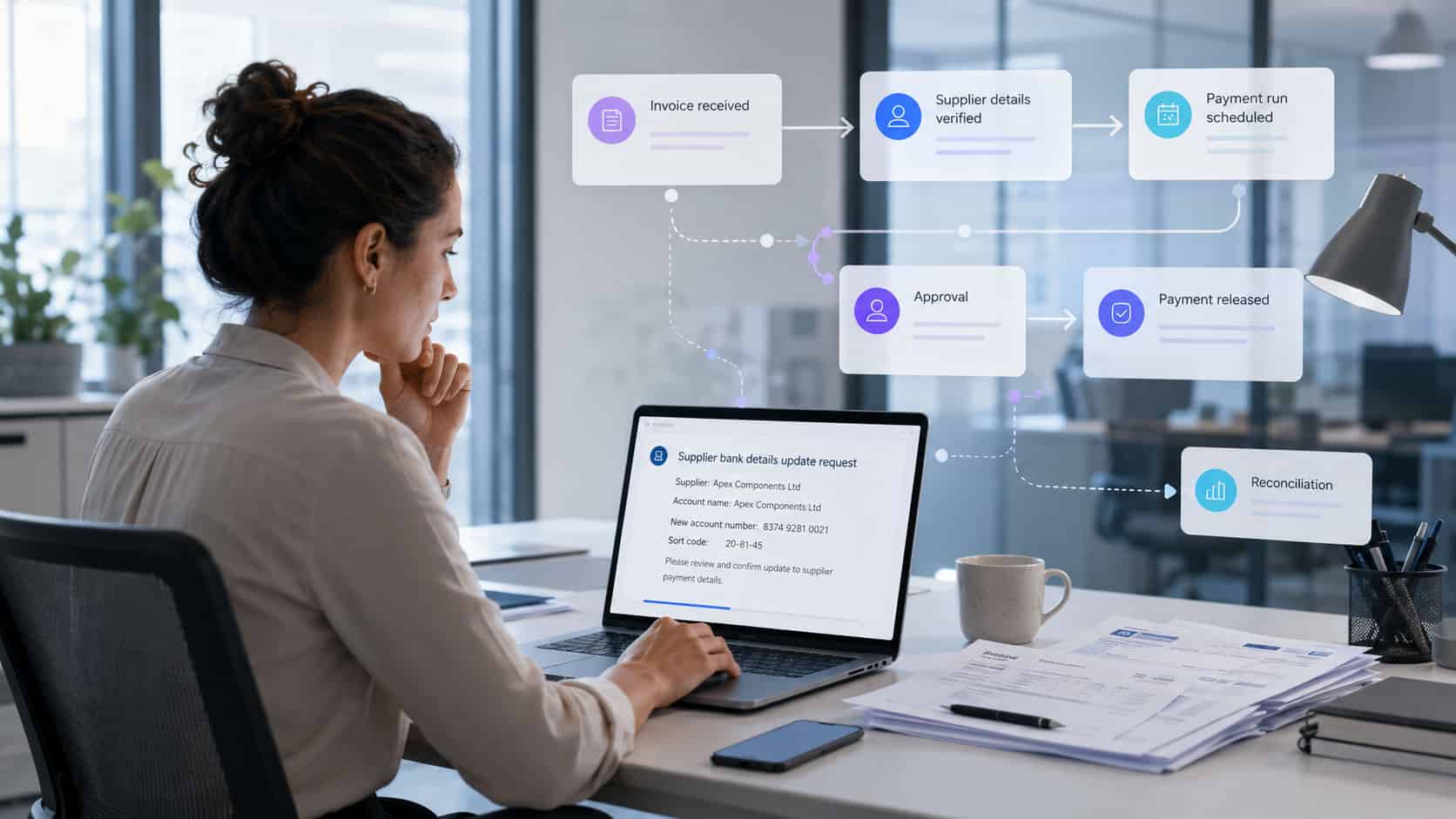
A finance team is trying to finish the month-end payment run.
Dave has a list of invoices open, a supplier has already chased twice, and the team wants to avoid holding up a project that depends on the payment being made. Nothing about the morning feels unusual. It is busy, but it is the kind of busy finance teams recognise.
Then an email arrives asking for supplier bank details to be updated before the next payment goes out.
The supplier name is familiar. The invoice number matches work already in progress. The tone is normal. The request fits the task Dave is already doing, so it does not feel like a cyber decision. It feels like another piece of admin in a day full of admin.
Dave updates the record and moves on.
Only later, when the payment has gone to the wrong account, does the story become simple. Dave should have checked. Dave should have spotted it. Dave made the mistake.
The incident is written up as human error.
That explanation feels tidy because it gives the business a person, an action and a consequence. But it can also cut the learning short. It starts with the final visible mistake, rather than the working conditions that made the decision feel reasonable at the time.
And that is where blame can put the business at risk.
What blame really is
Blame is what happens when responsibility is transferred onto a person instead of being examined across the situation that shaped the decision.
It usually appears after something has gone wrong. The business looks back, finds the person closest to the final action, and makes that person the explanation. Dave updated the bank details. Dave clicked the link. Dave shared the file. Dave approved the access. The incident becomes attached to Dave because Dave is the visible point where the outcome changed.
That can feel reasonable. A person did make a decision, and that decision had consequences.
But blame is narrower than accountability.
Accountability looks at the decision properly. It asks what Dave was responsible for, what should have happened, what support or control was available, and what needs to change so the same decision is less likely to happen again.
Blame stops sooner. It treats Dave as the cause, not as part of a wider working system. It moves responsibility away from the process, the pressure, the workflow, the expectations, the tool, the culture and the control design, and places it mainly on the individual.
That is why blame can be so attractive to a business. It creates a clean story. The organisation can say, “The process was fine. Dave failed to follow it.” The problem feels contained because responsibility has been moved onto one person.
But that clean story can be dangerous.
If Dave made the decision because the request looked normal, the payment run was under pressure, the verification route was easy to miss, and the team culture rewarded speed, then removing Dave does not remove the risk. It only removes the person who happened to be holding the decision when the weakness became visible.
Someone else can sit in the same chair tomorrow, face the same pressure, follow the same informal pattern, and make the same reasonable-looking decision.
That is the difference between blame and useful accountability.
Blame gives the business a person to correct.
Accountability gives the business a pattern to reduce.
Why “human error” feels like an answer
When something goes wrong, “human error” gives the business a clean story at a messy moment.
There is an incident, a visible action and a person connected to it. Dave updated the bank details. Dave trusted the email. Dave missed the verification step. The payment went to the wrong account. The sequence appears simple, and that simplicity can feel reassuring when the business is trying to understand what happened.
It also gives leaders something immediate to act on. Dave can be reminded of the policy. Dave can be sent back through training. The process can be restated. A message can go out telling everyone to be more careful.
None of that is automatically wrong. Sometimes a person does need more support, clearer guidance or correction. But the danger is that “human error” can make the business feel as though it has found the cause when it has only found the final visible action.
That is where the phrase becomes risky.
Human error identifies the point where the incident became obvious. It does not necessarily explain where the risk was created. It does not show why the request felt normal, why the check was missed, why the safer route was not followed, or why continuing felt like the reasonable thing to do at the time.
In Dave’s case, the issue is not simply that he updated the details. The useful question is why updating them from that message felt like a normal part of the payment run. The supplier was familiar. The invoice was live. The request matched work already in progress. The team was busy. The verification step existed, but it was not strong enough in the moment where the decision was made.
That is the part “human error” can hide.
It turns a decision shaped by workflow, pressure, trust and process design into a personal failure. It allows the business to correct Dave without fully examining the conditions that made Dave’s decision likely.
For a business, that is the real weakness in the phrase. It gives you someone to focus on, but not always something useful to change.
Why blame feels convincing after the incident
Blame feels convincing because it usually arrives after the ending is already known.
Once the business knows the payment went to the wrong account, the earlier decision looks different. The email now appears more suspicious. The missed check feels more obvious. The safer action seems clearer. Everyone can look back and see the point where Dave should have stopped.
But Dave did not make the decision from that position.
He made it while the payment run was live, the supplier was waiting, and the request fitted work already in progress. He was not looking at a completed incident. He was looking at a familiar task that needed finishing.
That gap between what people knew at the time and what the business knows afterwards is where blame becomes dangerous.
After an incident, it is easy to judge the decision by the outcome. Because the result was bad, the decision starts to look careless. Because the warning signs are now visible, it feels as though they should have been obvious all along. Because the safer route is clear in hindsight, the original action can look unreasonable.
But real decisions are not made with hindsight. They are made with partial information, competing priorities and the pressure of the task already underway.
That does not excuse the decision. It makes the decision worth understanding properly.
If the business only reviews the incident from the after-the-fact position, it may overestimate how obvious the risk was in the moment. It may assume Dave ignored a clear warning when, in reality, the warning was buried inside something that looked routine, legitimate and time-sensitive.
A useful review has to resist that pull. It has to go back into the moment before the outcome was known and look at the decision from inside the work: what Dave saw, what he was trying to complete, what made the request feel legitimate, and why continuing felt reasonable at the time.
Only then can the business learn from the incident without reducing it to a person-shaped explanation.
How blame hides the pattern
Blame makes an incident look smaller than it is.
It narrows the focus to the person closest to the final action, then treats that person as the main place where the problem lives. That can feel decisive. Dave updated the bank details, so Dave becomes the issue. Dave missed the check, so Dave becomes the fix.
But in cybersecurity, the visible mistake is often only where the pattern surfaced.
The deeper question is whether the same decision could happen again with someone else. If another person was working through the same payment run, under the same pressure, with the same familiar-looking request and the same weak pause point, would the safer decision be any more likely?
If the answer is no, the problem is bigger than Dave.
That is what blame can hide. It can make the business believe it has dealt with the risk because one person has been corrected, retrained or removed from the process. But the workflow remains the same. The pressure remains the same. The informal shortcut remains available. The verification step still depends on someone remembering to stop at exactly the moment the task is pushing them to continue.
The incident becomes personal when it should become instructive.
This is also why blame can damage reporting. If people believe the organisation mainly wants someone to blame, they are less likely to raise uncertainty early. They may hesitate before admitting they clicked something, nearly approved something, or felt unsure about a request that looked legitimate. That delay can give a small issue more time to grow.
A better response does not ignore the person’s decision. It looks at the decision in context. Dave may have made the final update, but the business needs to understand whether the conditions around that decision made the same outcome likely for the next person too.
That is where root cause analysis becomes useful.
Why root cause analysis has to go one step beyond human error
A better business response does not ignore the mistake. It investigates it properly.
This is where root cause analysis becomes useful, especially the simple discipline of asking “why” more than once. The 5 Whys approach is not complicated. It starts with what happened, then keeps asking why until the organisation moves beyond the surface event and gets closer to the condition that allowed it to happen.
The problem is that many businesses stop too early.
A payment has gone to the wrong account.
Why?
Because Dave in finance updated the supplier bank details from an email.
At that point, the incident can easily be labelled as human error. Dave becomes the explanation. Dave clicked, trusted, approved or updated the wrong thing. The corrective action becomes obvious: remind Dave of the policy, retrain Dave, restrict Dave, discipline Dave or move Dave away from that responsibility.
That may deal with Dave. It does not necessarily deal with the risk.
If the business asks one more why, the picture changes.
Why did Dave update the bank details from the email?
Because the request looked like a normal supplier change, arrived during a busy payment run, matched work already in progress, and the verification step was not built into the workflow in a way that felt immediate, expected or easy to apply under pressure.
Now the business has something more useful.
The issue is no longer just Dave. It is the way supplier changes are handled when finance work is moving quickly. It is the way legitimate-looking requests are treated. It is the way verification depends on one person remembering to pause at exactly the point where the task is already pushing them to continue.
That extra “why” changes the scale of the solution.
If the business stops at human error, it can remove Dave from the process and feel as though the issue has been addressed. But if the same pressure, same workflow and same weak verification route remain in place, the risk has not been removed. It has only been passed to the next person who sits in Dave’s chair.
If the business goes one why further, it can remove a chunk of risk from the organisation.
It can make supplier-change verification a fixed part of the payment process. It can require confirmation through a known route before any bank details are changed. It can make the approved process easier to follow during busy periods. It can give finance staff clear language for pausing a payment without feeling like they are causing unnecessary delay. It can make managers responsible for supporting the check, not just expecting individuals to remember it.
That is a different level of prevention.
The same applies beyond finance. If someone shares a file through the wrong route, stopping at human error focuses on the person who sent it. Going one why further may reveal that the approved sharing route is unclear, slow or not used consistently by the team. If someone approves access too quickly, stopping at human error focuses on the manager who clicked approve. Going one why further may reveal that access requests are framed as urgent productivity blockers, with no easy way to verify whether the access is appropriate.
Human error often identifies where the incident became visible. Root cause analysis should identify where the risk became likely.
That is the difference businesses need to understand.
A person may have made the final decision, but the organisation often shaped the conditions around that decision. When those conditions remain unchanged, the same kind of incident can happen again with a different name attached to it.
This does not remove accountability. It makes accountability more useful. Dave may still need support, guidance or correction. But the business also needs to ask what made Dave’s decision feel like normal work, and what needs to change so the safer decision is easier, clearer and more consistent next time.
That is where cyber learning becomes valuable. Not in proving that one person got something wrong, but in finding the repeatable pattern that the business can now reduce.
Moving from blame to better judgement
The businesses that handle cyber risk well are not the ones where nobody ever makes a mistake. They are the ones where uncertainty becomes visible early, decisions are supported properly, and incidents are used to improve the conditions around future choices.
That requires a different way of looking at people.
Staff are not careless obstacles to cybersecurity. They are people working inside real pressures, often trying to be helpful, efficient and responsive. Those qualities are valuable. The aim is not to make people suspicious of everything or scared to act. The aim is to help them recognise the moments where a normal task needs a little more judgement before it continues.
This is the difference between blame and learning.
Blame looks backwards and settles on the person. Learning looks at the decision and asks how the business can make the better action more likely next time.
That may mean making verification easier to use. It may mean giving teams clearer language for challenging unusual requests. It may mean helping managers respond well when someone pauses a task. It may mean practising realistic scenarios before pressure arrives. It may mean reviewing whether the official process actually works at the speed of the real workplace.
None of this removes accountability. It makes accountability more intelligent. It gives the business a clearer view of where risk is forming and a more practical route to reducing it.
Because the real danger is not that one person made one mistake. The bigger danger is that similar decisions are already happening across the organisation, quietly shaped by the same pressures, and nobody is looking closely because every incident keeps being filed away as human error.
That is why blame and “human error” can put your business at risk. They make the explanation feel complete before the business has understood enough to change the pattern.
A stronger starting point is simple: before blaming the person, look at the decision. Look at what they were trying to do, what made the action feel reasonable, and what the organisation can change so the safer decision is easier, clearer and better supported next time.
That is where better cybersecurity begins. Not with louder warnings. Not with more blame. With better judgement in the moments where normal work and cyber risk quietly meet.

Director of Training and Development, Cyber Rebels.
Andy Longhurst is the founder of Cyber Rebels and a cybersecurity practitioner and educator focused on how risk actually shows up in real organisations. His work sits at the intersection of digital safety, education, and practical risk management — helping teams understand not just what policies say, but what happens in the moments where decisions are made under pressure.
With a background spanning adult education, web development, and technical consultancy, Andy specialises in translating complex security concepts into clear, usable understanding. Rather than focusing solely on tools or compliance frameworks, his approach centres on human behaviour, judgement, and the systems that shape everyday choices.
He delivers live, interactive cyber awareness training for organisations of all sizes, from small businesses and education providers to public-sector teams and larger organisations operating in complex risk environments.
Outside of delivery, Andy spends his time analysing emerging attack patterns, refining training design, and exploring how organisations can build resilience that holds up in the real world — usually with a strategically sized cup of tea close to hand.