




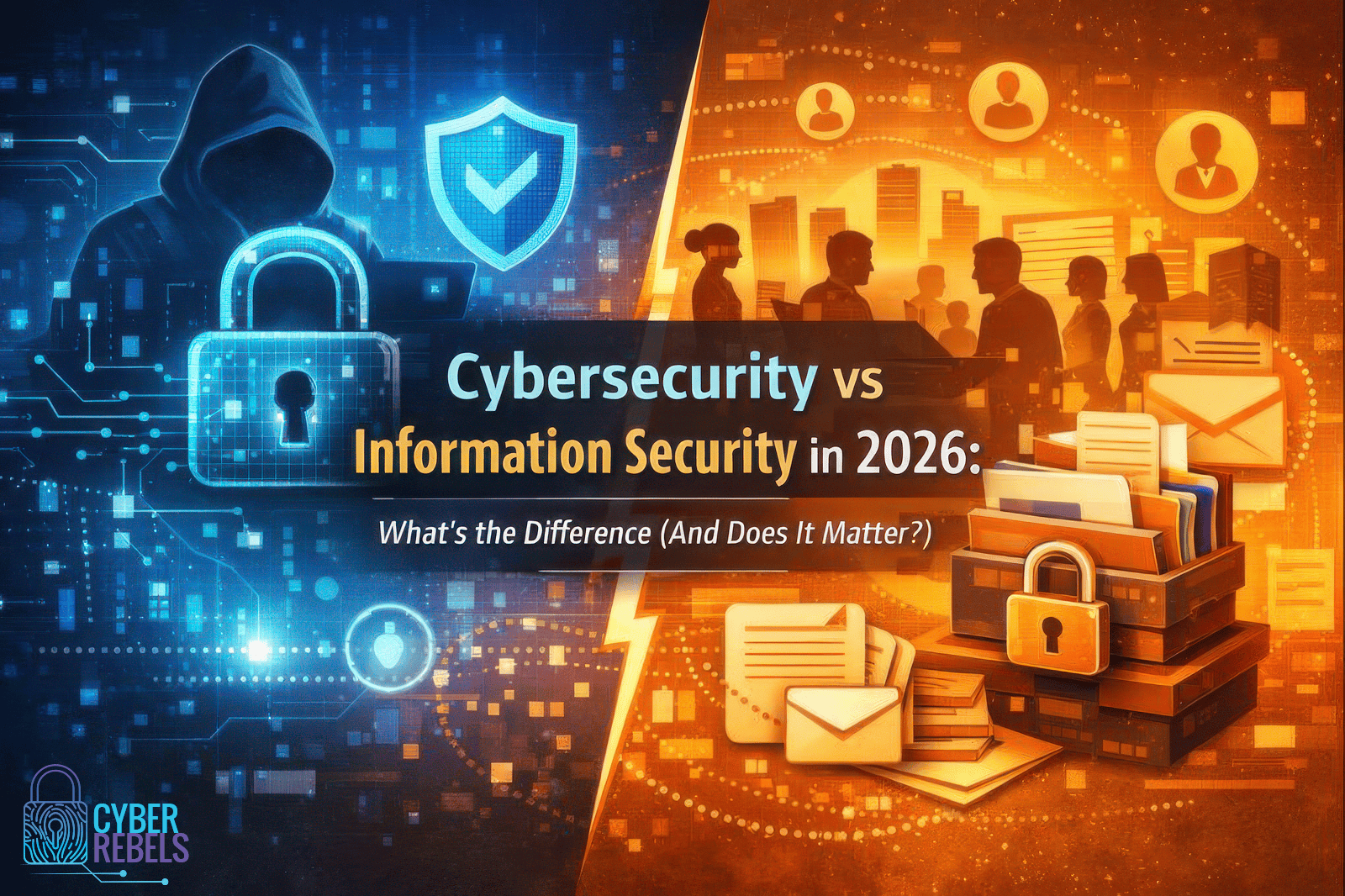
If you sit in enough meetings about risk, compliance, or “cyber”, you start to notice something interesting. The language changes, but the assumptions rarely do. Cybersecurity and information security are used as if they’re interchangeable. Different words, same meaning. Same budget line. Same responsibility.
Most of the time, no one challenges that assumption. It feels close enough. Security is security, right?
But this quiet blending of terms is one of the reasons so many organisations feel they are doing cybersecurity while still experiencing incidents, near misses, and uncomfortable conversations after something goes wrong. Not dramatic breaches. Not Hollywood-style hacks. Just moments where information ends up somewhere it shouldn’t have, and nobody is quite sure how it happened.
The problem usually isn’t effort, investment, or intent. It’s understanding. More specifically, it’s a misunderstanding of where risk actually shows up in day-to-day work.
So let’s start with the why, not the definitions. Because the reason this distinction matters has far less to do with terminology, and far more to do with how real people make decisions under pressure — especially when things don’t look like a “cyber incident” at all.
Why this question keeps coming up
Cybersecurity feels urgent. It’s visible. There are headlines, statistics, dashboards, threat alerts, and tools that promise protection. It’s something you can point at and say, “We’ve invested in this.”
Information security feels quieter. Slower. Less tangible. It shows up in policies, processes, training sessions, and conversations about behaviour. It doesn’t always come with flashing lights or graphs.
In busy organisations, especially smaller ones, the louder thing tends to win. Cybersecurity becomes the focus, and information security is assumed to be covered by default.
That assumption is where problems start.
Information security isn’t abstract — it’s everyday work
Information security is often talked about as if it lives in policies, frameworks, and compliance documents. Something formal. Something separate from the real work people are trying to get done.
In practice, it shows up in far more ordinary places.
It shows up in how emails are written and forwarded. In where documents are stored when someone needs to work quickly or remotely. In the conversations that happen in open offices, on video calls, or in shared spaces where confidentiality is assumed rather than checked. It shows up in screenshots taken for convenience, files renamed for clarity, and notes saved “just in case”.
None of these actions feel like security decisions at the time. They feel like work.
That’s the point. Information security doesn’t sit outside daily activity; it is woven into it. Every time someone decides how to create, share, store, or talk about information, they are making an information security decision, whether they realise it or not.
What makes this difficult is that most of these decisions are made under pressure. Deadlines matter. Helping colleagues matters. Keeping things moving matters. In those moments, people fall back on habit and judgement, not policy language. If the only guidance they’ve been given is a list of rules, those rules tend to blur or get bypassed when they don’t quite fit the situation in front of them.
This is why information security cannot rely solely on documentation or enforcement. It depends on shared understanding. People need to know not just what is classified as sensitive, but why. Not just which tools to use, but when extra care is needed. Not just what the “correct” process is, but what to do when reality doesn’t match the process perfectly.
Good information security acknowledges that work is messy. It accepts that people will adapt, improvise, and find workarounds. Rather than trying to eliminate that behaviour, it aims to guide it. It provides enough context for people to make safer decisions when no one is watching and no checklist quite applies.
When information security is treated as something abstract, it becomes easy to dismiss or forget. When it’s understood as part of everyday work, it becomes part of how people think. That’s when it stops being a compliance exercise and starts becoming a protective habit.
Where cybersecurity fits — and why it isn’t enough on its own
Cybersecurity is often treated as the starting point for security conversations, but in reality it is a response to a much broader problem. It exists to protect digital systems and data from deliberate attack, not to define how information should be handled in the first place.
Firewalls, endpoint protection, patching, monitoring, backups, and multi-factor authentication all play a critical role. They reduce exposure. They limit damage. They give organisations time to respond when something goes wrong. Without them, even small businesses would be left dangerously open.
But cybersecurity controls are, by design, reactive. They respond to known threats, detectable behaviours, and technical indicators. They work best in environments that are predictable and well defined.
Human work rarely is.
People don’t interact with systems in neat, repeatable ways. They adapt. They multitask. They work around friction. They trust familiar names, respond to urgency, and try to be helpful. None of this is malicious. It’s how work gets done.
Cybersecurity tools are not built to understand that context. They don’t recognise social pressure, hierarchy, or tone. They don’t know when someone feels rushed, distracted, or conflicted. They can’t tell the difference between a legitimate request made at the wrong time and a carefully crafted manipulation designed to look legitimate.
This is why so many incidents bypass technical controls entirely. Nothing “breaks”. No system is exploited. No alert fires. The tools work exactly as intended, while information quietly moves in ways no one planned for.
That doesn’t make cybersecurity ineffective. It makes it incomplete.
Cybersecurity works best when it operates inside a framework of clear information security understanding. When people know what information matters, why it matters, and what good handling looks like in practice, technical controls reinforce those decisions rather than trying to compensate for their absence.
Without that foundation, cybersecurity ends up carrying expectations it was never designed to meet. It becomes a safety net for behaviour it cannot see and cannot judge.
When organisations rely on cybersecurity alone, they often feel frustrated. They’ve invested in the right tools, followed best practice, and still experience incidents that seem to come from nowhere. In reality, those incidents usually originate from perfectly ordinary moments where technology had no reason to intervene.
Understanding where cybersecurity fits — and where it doesn’t — is what allows it to do its job properly.
The real reason incidents don’t look like “cyber attacks”
When people picture a cybersecurity incident, they tend to imagine something dramatic. An external attacker forcing their way in. Malware spreading across systems. A dashboard lighting up with alerts. A clear moment where “the attack” happens.
In reality, many incidents don’t start that way at all.
They start quietly, during ordinary work, with decisions that feel sensible at the time.
Imagine a small business during a busy period. A client needs information quickly. An employee receives an email that appears to come from a familiar contact, asking for a document they’ve shared before. The tone is polite. The timing feels urgent, but not unreasonable. Wanting to be helpful and keep things moving, the employee sends the file.
Nothing breaks. No system is compromised. No warning appears.
Later, it turns out the email wasn’t from who it claimed to be. The address was slightly altered, the context carefully copied from previous correspondence. By the time anyone realises, the information has already left the organisation’s control.
From a technical perspective, nothing failed. The email system worked as expected. Access controls were followed. No malicious link was clicked. No malware was introduced.
From an information security perspective, something important happened: trust was exploited, context was manipulated, and information moved in a way the organisation never intended.
This is why so many real-world incidents don’t resemble “cyber attacks” at all. They don’t arrive with obvious warning signs. They blend into normal work, relying on familiarity, urgency, and good intentions rather than technical weakness.
When organisations look back on these situations, it’s tempting to ask why someone didn’t spot the problem sooner. But that question misses the point. In the moment, there often wasn’t anything obvious to spot — just a decision made under pressure, without enough context to pause and question it.
That’s where most risk lives. Not in broken systems, but in ordinary moments where people are asked to make quick judgements about information, trust, and timing.
Why SMEs feel this more sharply
In smaller and medium-sized organisations, the line between formal process and informal practice is often thin. People wear multiple hats. Systems evolve organically. Workarounds develop because they’re practical.
This isn’t a criticism. It’s reality.
But it does mean that information security risk is often created in the gaps between roles, systems, and expectations. When everyone is trusted to “use their judgement” without being given a shared understanding of what good judgement looks like, inconsistency creeps in.
Cybersecurity tools can’t fix that. They weren’t designed to.
Information security, when approached properly, provides the shared context people need to make better decisions without slowing work to a crawl.
Training is where the distinction becomes visible
The difference between cybersecurity and information security becomes most obvious when organisations think about training. Not because training is the solution to everything, but because it’s where assumptions about risk are exposed.
A lot of cybersecurity training is built around threats. It teaches people what attacks look like, which links not to click, and which warning signs to memorise. This approach isn’t wrong, but it frames security as something that happens to the organisation. The risk is external. The role of staff is to avoid making mistakes.
Information security training starts from a different place. It looks at how information is actually used inside the organisation and asks where risk is created during normal work. It acknowledges that people don’t wake up intending to break policy. They’re trying to get through their day, meet expectations, and help others do the same.
When training focuses only on threats, it often creates anxiety rather than confidence. People become afraid of getting things wrong, which can lead to hesitation, silence, or attempts to hide mistakes. The learning becomes about avoidance rather than understanding.
Human-first training shifts that dynamic. It helps people understand why certain information needs protecting, how attackers exploit ordinary behaviour, and where judgement matters more than rules. Instead of memorising instructions, people develop a mental model of risk that they can apply in situations that don’t look like textbook examples.
This is especially important because real incidents rarely match training scenarios perfectly. They arrive wrapped in familiarity, routine, and social context. Training that only prepares people for obvious red flags leaves them exposed when those flags aren’t there.
When people understand the flow of information through their role, the pressures that influence their decisions, and the reasons behind controls, they’re better equipped to respond thoughtfully rather than reactively. They’re more likely to pause, ask questions, and escalate concerns early — not because they’re afraid of consequences, but because they understand the impact.
This is where the distinction truly matters. Cybersecurity training teaches people what to avoid. Information security training teaches people how to think. And it’s that shift in thinking that turns awareness into resilience.
The role of confidence in security behaviour
One of the most underestimated factors in effective security is confidence. Not technical confidence, but human confidence — the confidence to pause, to question, to speak up, and to admit uncertainty without fear of blame.
Most organisations say they want people to report concerns early, challenge unusual requests, and flag mistakes as soon as they happen. In practice, many environments unintentionally discourage exactly that behaviour. When security is framed primarily as a list of rules or a set of things that must not go wrong, people become cautious in the wrong ways.
They hesitate to ask questions in case they look inexperienced. They worry about escalating something that turns out to be “nothing”. They delay reporting mistakes because they’re embarrassed, unsure, or afraid of consequences. None of this is about negligence. It’s about psychology.
Confidence in security behaviour doesn’t come from knowing every rule. It comes from understanding intent. When people know why certain information matters and what the organisation is trying to protect, they feel more capable of making decisions when situations don’t fit neatly into policy language.
This matters because real work rarely presents clear-cut choices. Requests are ambiguous. Context is incomplete. Time pressure is real. In those moments, people rely on judgement, not documentation. If that judgement hasn’t been supported by explanation and trust, it defaults to speed and familiarity.
A fear-based approach to security quietly undermines confidence. When mistakes are treated as personal failures rather than learning opportunities, people become risk-averse in ways that actually increase risk. Issues are hidden. Near misses go unreported. Small problems are allowed to grow.
Human-first security recognises that confidence is protective. It creates space for uncertainty. It makes it acceptable to slow down and ask, “Does this make sense?” It reassures people that raising a concern is a sign of professionalism, not incompetence.
When confidence is present, behaviour changes in subtle but powerful ways. People check before sharing. They challenge urgency that doesn’t feel right. They escalate early because they understand the value of doing so. Not because they’re afraid of getting it wrong, but because they care about getting it right.
This is why confidence isn’t a soft or secondary concern. It’s a control in its own right. Without it, even the best technical measures are working against human hesitation and silence. With it, people become an active part of the organisation’s security posture rather than something to be managed around.
Why compliance quietly expects both
Most compliance frameworks don’t make a big song and dance about the difference between cybersecurity and information security. They don’t need to. The distinction is assumed.
When regulations talk about “appropriate technical and organisational measures”, they are describing two different kinds of protection working together. Technical measures cover systems, infrastructure, and digital controls. Organisational measures cover people, processes, training, accountability, and culture.
What’s often missed is that organisational measures are not just policies on paper. They rely on people understanding what those policies are trying to achieve and feeling confident enough to apply them in situations that don’t follow a script.
Compliance isn’t satisfied by the existence of controls alone. It expects those controls to function in practice. That means people recognising when something doesn’t feel right, knowing when to slow down, and feeling able to escalate concerns without fear or hesitation. It means training that goes beyond awareness and builds judgement. It means creating an environment where early reporting is normal, not exceptional.
This is why compliance frameworks rarely spell out behaviour explicitly, but consistently circle back to training, awareness, and accountability. They assume that organisations understand something fundamental: technology cannot compensate for confusion, silence, or misplaced trust.
An organisation can have strong cybersecurity controls and still struggle to demonstrate compliance if staff don’t understand their role in protecting information. Equally, well-written policies mean very little if people don’t feel confident applying them under pressure.
Compliance quietly expects both cybersecurity and information security to be present, not as separate initiatives, but as a combined system where tools support behaviour and behaviour reinforces tools. When that balance is missing, compliance becomes brittle. It may look fine on paper, but it breaks down the moment real-world complexity enters the picture.
Seen this way, compliance isn’t about satisfying an external requirement. It’s about demonstrating that an organisation understands how risk actually shows up in day-to-day work — and has equipped its people accordingly.
The real cost of misunderstanding the difference
When organisations treat cybersecurity and information security as the same thing, the result is often quiet frustration. Tools are purchased, policies are written, training is delivered — and yet risk persists in ways that feel hard to explain.
Over time, this leads to a familiar conclusion: people “just don’t get it”, or that more rules, more reminders, or more controls are needed. In reality, the issue is rarely effort or attitude. It’s understanding.
People can follow instructions without understanding them, but they can’t adapt those instructions intelligently when circumstances change. And circumstances always change. Work doesn’t pause for perfect conditions. Requests arrive without context. Decisions are made under pressure.
Information security provides the context that allows cybersecurity controls to work as intended. Without that context, technical measures end up carrying expectations they were never designed to meet, and are quietly bypassed or worked around in the name of getting things done.
This is where security often becomes misunderstood as a burden. When it’s framed as something that exists to restrict behaviour, it naturally creates friction. People look for the fastest way around it, not because they’re careless, but because they’re trying to work.
A human-first approach starts from a different assumption. It recognises that security exists to enable safe, confident work. When people understand how their actions protect information, security becomes part of how work is done rather than something bolted on afterwards.
This is why language matters more than it seems. Referring to everything as “cybersecurity” subtly shifts responsibility away from everyday decisions and towards technology. Framing it as information security brings the focus back to judgement, behaviour, and the reality of how information is actually handled.
So yes, the difference does matter — not because one term is more correct than the other, but because understanding the distinction changes where you look for risk. It shifts attention from tools to decisions, from systems to behaviour, from fear to understanding.
Cybersecurity protects infrastructure.
Information security protects judgement.
When organisations grasp that, the conversation changes. They stop asking whether their people are the weakest link and start asking whether their people have been given the clarity, confidence, and context they need to make good decisions.
That’s where real resilience begins.
The Cyber Rebels perspective
At Cyber Rebels, we don’t see cybersecurity and information security as competing ideas. In practice, we see cybersecurity as one of the tools information security depends on — and people as the foundation both ultimately rely on.
That view didn’t come from theory. It came from watching the same patterns repeat across different organisations, sectors, and roles. More than once, I’ve seen businesses invest heavily in the “right” tools, only to discover later that an incident slipped through because someone was rushed, unsure, or didn’t feel able to question what they were being asked to do.
That’s why our approach starts with how people think, decide, and behave around information. Not because technology doesn’t matter, but because no amount of technology can compensate for confusion, urgency, or silence when something doesn’t feel right.
Security that actually works isn’t about catching people out or assuming they’re the problem. It’s about giving them the clarity and confidence to act before a small issue becomes a bigger one. Bringing people into the conversation, rather than building controls around them.
Once you understand that, the difference between cybersecurity and information security stops being an academic distinction. It becomes practical, visible, and relevant to everyday work — exactly where real security lives.

Director of Training and Development, Cyber Rebels.
Andy Longhurst is the founder of Cyber Rebels and a cybersecurity practitioner and educator focused on how risk actually shows up in real organisations. His work sits at the intersection of digital safety, education, and practical risk management — helping teams understand not just what policies say, but what happens in the moments where decisions are made under pressure.
With a background spanning adult education, web development, and technical consultancy, Andy specialises in translating complex security concepts into clear, usable understanding. Rather than focusing solely on tools or compliance frameworks, his approach centres on human behaviour, judgement, and the systems that shape everyday choices.
He delivers live, interactive cyber awareness training for organisations of all sizes, from small businesses and education providers to public-sector teams and larger organisations operating in complex risk environments.
Outside of delivery, Andy spends his time analysing emerging attack patterns, refining training design, and exploring how organisations can build resilience that holds up in the real world — usually with a strategically sized cup of tea close to hand.