



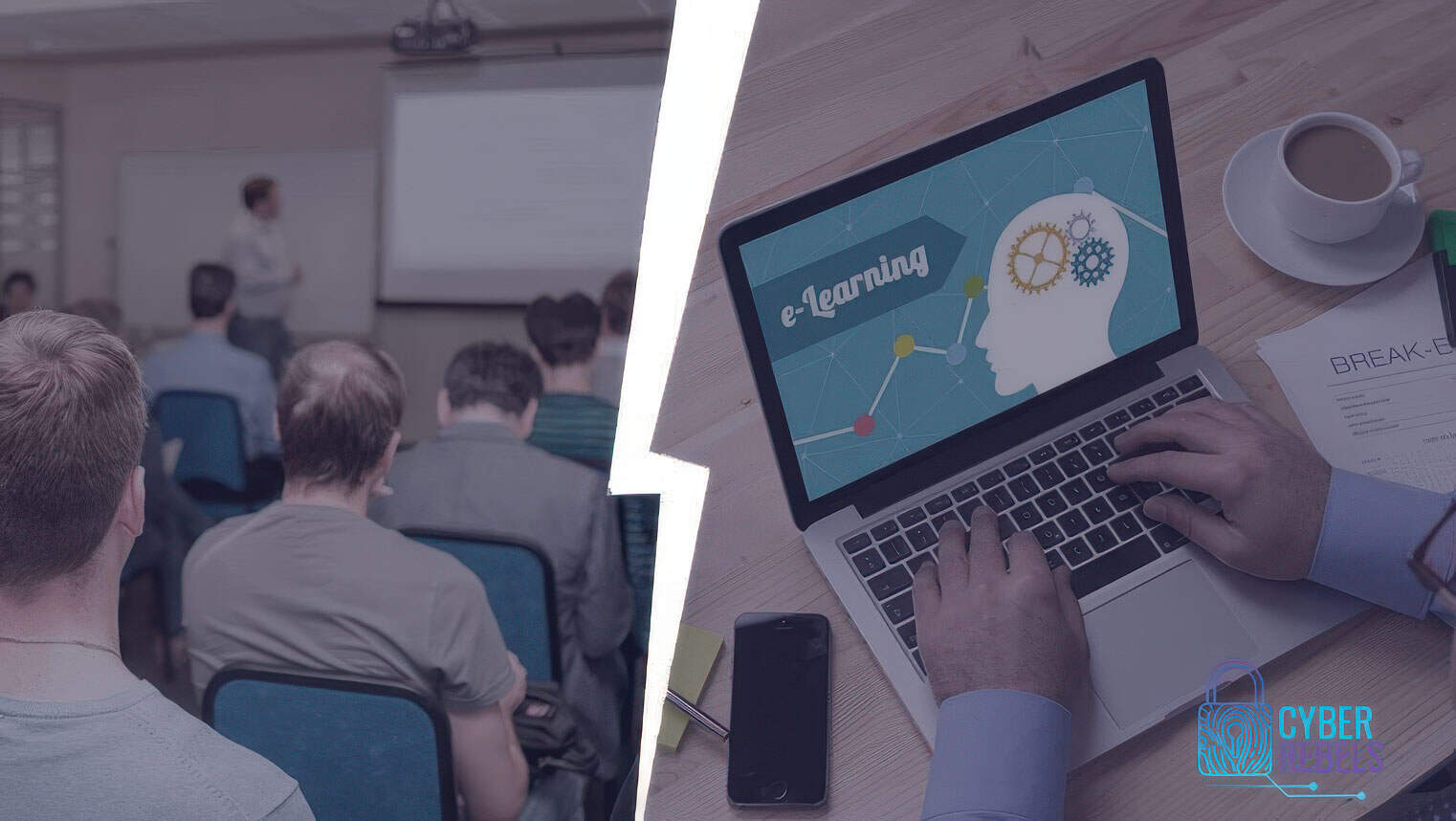
Cybersecurity training is no longer optional. If your business handles data, relies on digital systems, or connects to the internet (which is, realistically, all businesses), you need to train your people to spot threats and respond safely.
But once you’ve committed to training, the next decision is harder: how should you deliver it?
Do you invest in live workshops and real-time sessions, or roll out online modules that staff can complete at their convenience? Does it even matter which format you choose—as long as it ticks the compliance box?
The truth is, the format you choose will shape the impact of your training. And in cybersecurity, impact isn’t measured by certificates—it’s measured by whether your team makes safer decisions, spots threats early, and avoids preventable mistakes.
This blog unpacks the real differences between live and online cybersecurity training. We’ll explore engagement, behaviour change, relevance, and cost—and show you why businesses serious about cyber resilience should be looking beyond convenience to what actually works.
What Do We Mean by ‘Live’ and ‘Online’?
Let’s start with a definition.
Live cybersecurity training refers to sessions delivered in real time—either in-person at your workplace or virtually via platforms like Zoom or Teams. These sessions are usually led by an expert trainer and include interaction, questions, exercises, and often live demonstrations or simulated threats.
Online training, by contrast, typically means pre-recorded, self-paced courses delivered via an e-learning platform. These may include videos, quizzes, reading materials, or animations. Learners can access them at any time and complete them independently.
Some businesses also adopt blended learning, combining both formats—often using online modules for foundational knowledge and live sessions for deeper engagement or reinforcement.
Both have their place. But they’re not equally effective across all objectives—and when it comes to real-world behaviour change, the difference is significant.
The Case for Live Training
When we talk about live cybersecurity training, we’re talking about engagement with impact. It’s not about delivering content—it’s about transforming behaviour in real time. Here’s why live sessions consistently outperform passive formats:
1. Engagement Through Human Connection
Live training engages the brain differently than pre-recorded content. According to the National Training Laboratories’ Learning Pyramid, people retain up to 90% of what they learn through active participation, compared to just 5–10% for reading or passive listening.
Real-time sessions tap into this by offering two-way interaction. Participants can ask questions, clarify doubts, and get immediate feedback. That interaction boosts attention, improves understanding, and builds memory through social learning—a core principle in adult education theory. Put simply: when learners are part of the experience, they learn better.
We’ve seen this in countless live sessions. In one recent workshop, we ran a live social engineering exercise. We showed attendees a friendly email from “IT Support” asking them to verify their login details due to a routine system upgrade. Almost everyone nodded along—it looked professional, polite, and believable. Then we broke it down: the spoofed sender domain, the urgent language, the tiny inconsistencies in formatting. You could see the shift in the room. What seemed harmless suddenly felt personal. People started sharing stories—“I’ve had one like that!” or “I clicked something similar last year!” That conversation changed the tone entirely. It wasn’t theory anymore—it was their real inboxes, their everyday decisions. And that’s the value of live training: it creates moments that stick, challenge assumptions, and change habits long after the session ends.
2. Tailored to Sector, Risk Profile, and Real Scenarios
Generic advice can feel abstract. Telling someone “watch out for phishing emails” is easy to ignore—especially when it doesn’t seem relevant to their role. But when cybersecurity training reflects how your business actually works—your systems, your clients, your risks—it clicks.
Take this example: a phishing simulation built around invoice fraud is far more meaningful to a finance team than a generic talk on email safety. A session on secure messaging hits harder when it references real tools like Slack, WhatsApp, or Microsoft Teams—platforms your staff already rely on.
This isn’t just opinion—it’s supported by educational research. According to Merrill’s First Principles of Instruction (2002), people learn best when training is built around real-world tasks, not abstract theory. The learning sticks when it solves a problem the learner actually faces. That’s why a phishing exercise about invoice fraud works better for a finance team than a generic video on email safety.
The principles also emphasise the importance of building on what people already know. If the example feels familiar—say, a client sending a file via WeTransfer or an urgent Microsoft 365 alert—it activates prior knowledge and strengthens recall. People connect the dots more quickly.
Live training also allows people to actively apply what they’re learning, whether it’s spotting red flags in a mock email or deciding how to respond to a suspicious phone call. That hands-on interaction is where behaviour starts to shift.
And crucially, real-time feedback makes mistakes meaningful. When someone misidentifies a scam in a live session and the trainer breaks it down on the spot, they’re far more likely to remember the lesson. That moment of “ah—I see what I missed” lands deeper than any quiz score.
Finally, Merrill emphasises that learning must transfer into real-world use. That’s only possible when training is directly relevant to the systems, threats, and decisions your people deal with every day. When the examples match your tools and workflows, the leap from learning to doing becomes much shorter.
3. Real-World Scenarios Improve Risk Response
Threats don’t appear with warning labels. People make decisions under time pressure, distraction, or uncertainty. That’s why live sessions focus on situational learning—scenarios where learners are asked to think, decide, and respond.
Live simulations help participants build muscle memory. Just like fire drills prepare teams to exit a building quickly, phishing simulations and hands-on exercises prepare staff to recognise and respond to red flags under pressure.
We’ve delivered live simulations where participants were visibly shaken by how easy it was to be fooled—and thankful they weren’t learning the hard way, during a real breach.
4. Creates Team Accountability and Cultural Shift
Cybersecurity isn’t an individual pursuit—it’s a team sport. When live training is delivered across a department or organisation, it creates shared understanding, shared vocabulary, and shared responsibility.
This can’t be overstated: culture is built in the room, not in the LMS. People remember conversations, jokes, cautionary tales, and callouts from their peers far more than any slide deck.
Live training brings cybersecurity out of the IT silo and embeds it into how teams communicate and work. That’s when it becomes habit, not homework.
5. Builds Trust and Psychological Safety
One of the silent dangers in cybersecurity is fear. Employees often avoid reporting suspicious activity because they worry about being blamed or ridiculed. That silence creates space for breaches to grow.
Live sessions offer a rare opportunity to shift this dynamic. When a trainer says, “There’s no such thing as a stupid question,” and means it—when someone admits they nearly fell for a scam and gets supported, not mocked—it changes the tone.
Psychological safety, the belief that you won’t be punished for mistakes or questions, is one of the strongest predictors of learning and innovation at work (Google’s Project Aristotle, 2015). Live training creates that space. Online courses don’t.
The Pros of Online Training
Let’s be clear: we’re not anti-online training. There are legitimate, important reasons why some organisations choose it. When used wisely, it can complement a broader security culture. Here’s where it works:
1. Cost-Effective for Large or Distributed Teams
If your company has 500+ staff, the cost per person of a self-paced module is low. There’s no need to book sessions, hire trainers repeatedly, or manage scheduling conflicts. Everything scales.
For compliance-focused organisations, especially in regulated sectors where annual training is mandated, this scalability can be a logistical lifesaver.
But it’s worth noting: cost-effective doesn’t always mean risk-effective. If you save £2,000 on training and lose £20,000 in a breach because staff didn’t retain the key lessons, the savings vanish.
2. Quick Rollout and Instant Access
Online training can be deployed quickly, especially when you’re onboarding new staff or reacting to emerging threats. It allows for centralised control over who’s completed what, and many platforms include automated reminders and reporting dashboards.
This can help meet compliance obligations. In fact, many ISO 27001 and Cyber Essentials frameworks recommend documented training, which online platforms easily support.
But ticking a compliance box doesn’t guarantee real-world protection—it just proves you made the information available.
3. Flexibility for Learners
In remote, hybrid, or shift-based environments, asynchronous learning can be a necessity. Employees can complete training at their convenience, repeat tricky parts, and engage at their own pace.
That flexibility is especially helpful for global teams, part-time staff, or those who struggle with traditional learning environments. And for topics that don’t require discussion—like password setup or device encryption—online content can be a solid starting point.
However, flexibility often invites multitasking, which undermines effectiveness. Without external pressure or interaction, even the most well-designed courses can become background noise.
4. Useful for Onboarding and Knowledge Refreshers
Online training can serve a valuable purpose as a first introduction to cybersecurity concepts. For new hires or non-technical staff, simple courses can lay a foundation.
We’ve seen success when businesses use online modules for onboarding, followed by deeper, live sessions for real-world application. That layered model works because it respects both learning formats—but doesn’t rely solely on one.
Still, online content is only useful when it’s current, relevant, and reinforced. A 15-minute phishing module from 2018 won’t protect your team from today’s AI-powered scams.
The Downside of Each Format
Every training format has its trade-offs. Understanding the limitations isn’t about picking a winner—it’s about making informed decisions based on what actually reduces your risk. Let’s take a closer look at where each method can fall short.
The Pitfalls of Online-Only Training
Perhaps the most significant issue with self-paced online training is its vulnerability to “tick-box syndrome.” Employees complete the course to satisfy a requirement, but the lessons don’t sink in. There’s no conversation, no correction, and no context—just a string of screens to get through and a quiz to pass at the end.
This disconnect matters. In cybersecurity, awareness without action isn’t enough. If someone can recite what phishing is but still clicks on a suspicious link, the training hasn’t done its job.
Another problem is engagement drift. Online modules compete with distractions—emails, Slack messages, background noise, or just a lack of urgency. We’ve spoken to business owners who admitted their teams were “watching Netflix on one screen and training on the other.” That’s not a learning environment—it’s a checkbox exercise dressed up as education.
There’s also the issue of generic content. Many off-the-shelf courses use broad, industry-agnostic examples. They explain what ransomware is, but not how it might affect your remote finance team logging into a cloud CRM from a personal device. Without relevance, learners tune out. And without relevance, behaviour rarely changes.
And finally, while online platforms offer data tracking, the metrics can be misleading. Completion rates don’t equal competency. You might know who’s watched the videos—but you don’t know who’s ready to respond to a real incident.
The Realities of Live Training
Live training isn’t perfect either, and it’s important to be transparent about what it takes to do it well.
First, logistics matter. Scheduling live sessions—especially across departments or time zones—requires planning. You’ll need to coordinate calendars, book time out of busy schedules, and commit to making training a shared priority. For businesses running lean or working across multiple sites, this can be a hurdle.
There’s also the issue of cost perception. On the surface, live training appears more expensive. You’re paying for an expert’s time, sometimes travel, and often delivery to small or segmented groups. But this overlooks the long-term cost of ineffective training. A single cyber incident—triggered by one poor decision—can easily cost 10 to 20 times more than a live workshop. The return on investment is real, but it’s not always visible on a procurement spreadsheet.
Scalability is another consideration. For businesses with hundreds or thousands of staff, it can be difficult to deliver consistent live sessions at scale. Not every employee will have the same experience, especially if different trainers or formats are used across offices.
Lastly, live training depends on delivery quality. Not all sessions are equal. A disengaged facilitator or a rigid script can ruin the potential for behavioural change. That’s why it’s crucial to work with providers who don’t just understand cybersecurity, but also know how to teach it effectively—adapting in the moment, responding to questions, and tailoring content on the fly.
What Actually Changes Behaviour?
At the heart of every cybersecurity training decision is a simple question: will this change how people behave when it matters most?
It’s easy to confuse knowledge with action. Most people know they shouldn’t reuse passwords. They’ve heard of phishing. They may even know that USB sticks can carry malware. But knowing what to do doesn’t always translate into doing it—especially under pressure, distraction, or social engineering.
That’s why behaviour change—not content completion—is the true test of cybersecurity training.
Behavioural science offers some valuable clues. The Fogg Behaviour Model, for example, tells us that people take action when three elements converge: motivation, ability, and a prompt. In cybersecurity terms, that means we need to:
 Make people care (motivation),
Show them how (ability),
And create the habit to act at the right time (prompt).
Live training has a unique ability to influence all three.
Motivation through Emotion
People are more likely to remember and act on lessons that make them feel something. In our live sessions, we’ve seen teams go quiet when they realise a scam email we show them looks exactly like one they nearly clicked on last week. We’ve seen staff openly admit they’d have fallen for a fake calendar invite or spoofed supplier invoice—until the training gave them the tools to spot the red flags.
These moments matter. They build emotional relevance, and that fuels motivation. Online modules can certainly convey risk, but it’s rare for them to create that same internal “this could happen to me” realisation.
Ability Through Practice
Reading about phishing isn’t the same as spotting it under pressure. That’s where practice makes the difference.
Live training allows people to practise skills in context—to test their instincts, see the consequences of mistakes, and learn from peers in a psychologically safe environment. Whether it’s flagging suspicious emails during a simulation, roleplaying a scam call, or discussing incident reporting protocols, this kind of rehearsal builds muscle memory.
Online training can reinforce these ideas, but it rarely challenges learners to act in the moment. And in cybersecurity, acting in the moment is everything.
Prompts That Stick
Training needs to create mental shortcuts—triggers that prompt safe behaviour without conscious effort. These cues are often formed through stories, shared language, or peer learning. In a live session, when a team laughs at a convincingly fake email or debates whether a message looks dodgy, they’re building reference points. The next time something feels “off” in their inbox, that memory becomes the prompt to pause, question, and act.
These prompts can be built online too—but they’re more likely to form when people are engaged, reflecting out loud, and emotionally invested.
So What Does This Mean for Businesses?
It means that both formats have value—but not equal weight when it comes to shaping behaviour.
Online training is useful for introducing concepts, delivering consistent messages, and refreshing knowledge. It’s a key part of the learning journey.
But if you want to change habits, reduce real-world incidents, and build a security-first culture, then live training is the format most likely to get you there. Not because it’s flashier—but because it’s human. And cybersecurity—despite the tech—is a human problem at its core.
A 2022 study by the European Union Agency for Cybersecurity (ENISA) found that organisations that combined live, interactive training with simulations reported a 60% drop in successful phishing incidents over 12 months, compared to only 14% in organisations using self-paced modules alone. That difference isn’t just statistical—it’s operational. It’s fewer ransomware infections, fewer compromised accounts, fewer panicked calls to IT.
Live training creates the kind of emotional resonance and practical rehearsal that embeds learning at the behavioural level.
Let’s put it another way: online training gives people information. Live training gives them the instincts to act. And when that suspicious email lands or that odd phone call comes through, instincts—not knowledge—are what make the difference.
So What Should Your Business Choose?
If you’ve read this far, one thing should be clear: the format you choose isn’t just a delivery decision—it’s a strategic one. Because the type of training you invest in shapes not just what your team knows, but how they behave, how they report issues, and how confidently they act in the face of risk.
So how do you choose the right fit?
Start with your objective—not just your budget.
If your goal is to meet basic compliance requirements or provide entry-level awareness to a broad team, a well-structured online course can be a good starting point. It’s accessible, scalable, and cost-effective—especially for very large teams or as part of onboarding. But that format alone likely won’t shift deep habits or prepare people for high-pressure situations. It tells people what to do, but it rarely prepares them to do it.
If your goal is to build genuine resilience, reduce incident rates, or embed cyber thinking into day-to-day decisions, then live training is the stronger choice. It connects with people on a human level. It creates the kind of “lightbulb” moments that people remember. And it builds a shared language across teams—something that’s hard to measure, but essential in the moments that matter.
Consider your risk exposure.
Some businesses handle sensitive data. Some face insider threats or complex supply chains. Others manage frontline teams with high exposure to scams and social engineering. If your business falls into these categories—or operates in a regulated industry like finance, healthcare, or legal—then training needs to reflect your actual risks.
That’s where live sessions stand out. They can be tailored. They can adapt mid-session. They allow you to focus on the scenarios that are most likely to catch your team off guard.
Online training is usually static and standardised. You can choose a module on phishing or password hygiene, but it won’t know your tech stack, your customer base, or your attack surface.
Think about timing, continuity, and reinforcement.
Training shouldn’t be a one-off event. The best results happen when businesses layer learning over time—starting with awareness, followed by hands-on experience, then reinforced with bite-sized refreshers or phishing simulations.
That’s where blended models can work well: a short online course to cover the basics, followed by a live workshop to embed the learning, then phishing tests or policy updates to keep the momentum going. The sequence matters more than the format in isolation.
Too often, businesses pick a single format based on convenience or price, then feel disappointed when behaviour doesn’t change. The issue isn’t that training “didn’t work”—it’s that it wasn’t designed to stick.
And finally: ask yourself what failure would cost.
This is the real litmus test. What would it cost your business if one employee, under pressure, clicked the wrong link? Or responded to a spoofed invoice? Or reused a compromised password?
According to the UK Government’s Cyber Security Breaches Survey 2024, the average cost of a cyberattack for a medium-sized business is £15,300, not including reputational damage, regulatory fallout, or loss of customer trust. In larger organisations, the cost rises exponentially.
Compare that to the cost of a half-day live training session—often less than what one missed phishing email could cost you. It’s not just a learning investment. It’s risk mitigation. It’s insurance with lasting value.
Take the First Step Toward Safer Decisions
Cybersecurity isn’t just a knowledge problem—it’s a behaviour problem. And solving it takes more than policies and online modules. It takes training that feels real, speaks your team’s language, and prepares people to act—not just pass a quiz.
That’s where we come in.
At Cyber Rebels, we design live, hands-on training experiences that do more than inform. We help teams think critically, spot threats under pressure, and build habits that last—whether through on-site workshops, virtual sessions, or fully tailored programmes that reflect your sector and risk profile.
If you’re ready to move beyond surface-level awareness and create a culture of cyber confidence, let’s talk.
👉 Explore your options or book a free consultation
Let’s build something that actually protects your business.

Director of Training and Development, Cyber Rebels.
Andy Longhurst is the founder of Cyber Rebels and a cybersecurity practitioner and educator focused on how risk actually shows up in real organisations. His work sits at the intersection of digital safety, education, and practical risk management — helping teams understand not just what policies say, but what happens in the moments where decisions are made under pressure.
With a background spanning adult education, web development, and technical consultancy, Andy specialises in translating complex security concepts into clear, usable understanding. Rather than focusing solely on tools or compliance frameworks, his approach centres on human behaviour, judgement, and the systems that shape everyday choices.
He delivers live, interactive cyber awareness training for organisations of all sizes, from small businesses and education providers to public-sector teams and larger organisations operating in complex risk environments.
Outside of delivery, Andy spends his time analysing emerging attack patterns, refining training design, and exploring how organisations can build resilience that holds up in the real world — usually with a strategically sized cup of tea close to hand.